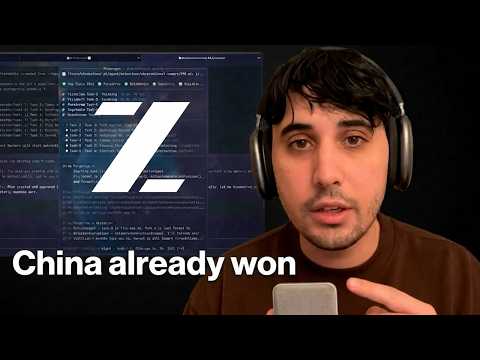
He spent $7k of his own money to make GLM-5.2 better - 0xSero

Video thumbnail: He spent $7k of his own money to make GLM-5.2 better - 0xSero
Jun 24, 20261h 35m 53s video lengthDavid Ondrej

The Signal

Local AI is no longer a marginal hobby; it is a viable, high-throughput tool for professional engineering and agentic work. The central tension lies in whether access to frontier intelligence will remain open and decentralized—like the internet or Bitcoin—or become a gated commodity restricted by governments and a few dominant commercial labs.

The Case

The Shift to Local Utility

  • The speaker claims local AI is already economically substitutable for cloud workflows, reporting a personal usage of 374 million tokens per month on his home setup.0:37
  • Using rigs built with Nvidia RTX 6000-class GPUs and DGX Spark modules, he demonstrates models like GLM-5.2 and DeepSeek-V4-Flash performing useful, concurrent tasks such as UI generation and file management.
  • Local deployment is argued to be a 'freedom technology' necessary to hedge against the loss of cloud access, citing the sudden removal of the high-performing Fable model as a warning.10:34

Access and Governance

  • The speaker predicts AI access will be tiered by governments and corporations via sanctions, enterprise contracts, and institutional gatekeeping, effectively walling off frontier models from ordinary consumers.21:23
  • While he acknowledges that models require regulation to mitigate existential risks like bio-misuse and automated cyber-exploits, he frames the centralization of these systems as a threat to individual autonomy and long-term economic competitiveness.11:19
  • Audience polling on his channel shows overwhelming preference (82%) for open-source and decentralized AI, reinforcing the view that users see owned compute as a necessary protection against censorship and platform-level bans.90:44

Hardware Strategy

  • For those building local capacity, the speaker advises a tiered investment approach: starting with rented cloud hardware to validate performance, then scaling home rigs in clean increments to avoid thermal and power-circuit failures.50:07
  • He identifies Nvidia as the current standard for frontier-speed inference, while noting that memory-heavy systems like Macs provide an alternative for users prioritizing capacity over raw generation speed.50:42

The 1 Minute Signal Take

The fundamental struggle for AI isn't just about raw model capability, but who holds the keys to the compute that runs it. Investing in local hardware now is a strategic hedge against a future where elite-level intelligence is permissioned by states or private labs.

Pro Analysis

Why It Matters

This content marks a shift from 'AI as software' to 'AI as infrastructure.' By treating GPU clusters with the same seriou...

Full analysis always available on Pro.

Time saved:1h 33m 54s

Share this

Tags