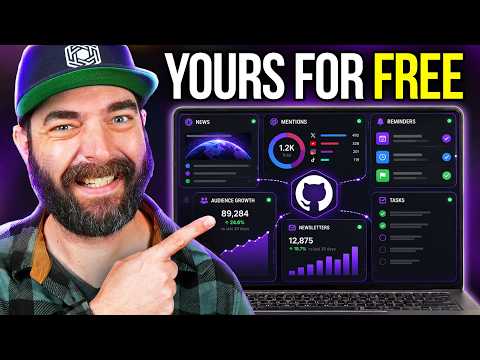
I Built a FREE App That Runs Your Entire Business

Video thumbnail: I Built a FREE App That Runs Your Entire Business
Aug 26, 202627m 37s video lengthMatt Wolfe

The Signal

Matt Wolf — a digital creator focused on building bespoke productivity tools — has released an open-source “control center” dashboard designed to consolidate business monitoring into a single interface. The system automates the ingestion and deduplication of high-volume feeds, including industry news, brand mentions, and newsletters, while offering optional AI-assisted ranking for prioritized review. The core trade-off is between the system's high level of personalization and the technical overhead required to configure it.

The Case

System Architecture

  • The dashboard functions as a multi-source monitoring layer that aggregates industry news, audience metrics, tasks, and mentions into a configurable set of modules.1:37
  • Users can connect specific AI API keys to improve content ranking, summarization, and relevance filtering, though the system operates effectively as basic infrastructure without AI.18:07
  • A dedicated newsletter module uses Gmail OAuth to ingest 48 separate newsletters, reducing them into a consolidated list of 156 deduplicated stories to prevent redundant manual review.12:04

Build and Deployment

  • The project is hosted on GitHub as a local-first application, though paid ChatGPT Pro users can host the dashboard on ChatGPT servers to enable remote browser access.25:05
  • Initial builds are described as functional “rough bones” that require several hours of iterative debugging; the speaker emphasizes that the dashboard requires user-specific configuration to be effective.3:56
  • The system filters out irrelevant noise, such as name-collisions for the speaker's brand, and supports local, offline model operation via integrations like LM Studio or Ollama for those prioritizing privacy over cloud-based AI providers.9:10

The 1 Minute Signal Take

This project demonstrates the current shift toward building bespoke, single-task productivity environments rather than relying on disparate SaaS tools. While the dashboard offers powerful deduplication and aggregation, its long-term utility is entirely dependent on the user’s willingness to maintain the technical stack and refine the filtering logic over time.

Pro Analysis

Why It Matters

This content highlights a shift from using AI as a standalone chatbot to using it as the 'glue' that holds custom software workflows together. It demonstrates that the most significant productivity gains today are found not in new models, but in the intelligent, automated piping of existing information channels.

Strategic Implications

Businesses are increasingly vulnerable to 'fragmentation fatigue,' where valuable insights are buried in silos. By centralizing monitoring, an individual or a small team can achieve an outsized view of their industry, turning raw, noisy data into a competitive intelligence feed. The move toward local, open-source dashboarding also suggests a growing demand for control over one's own data and AI execution environments.

Evidence & Hype Audit

This is a demonstration, not a controlled study. While the tool works, the speaker’s claims about it being the 'ultimate' app are subjective marketing. The technical instructions are accurate and reproducible, but the efficacy of the AI-driven ranking remains unbenchmarked.

Counterarguments

The setup cost is non-trivial. For many users, the time spent maintaining, debugging, and configuring this custom 'control center' may exceed the time saved from the automation itself. Furthermore, centralizing everything into one dashboard creates a single point of failure in one's personal workflow.

Who Should Care

  • Solopreneurs & Founders: For those managing multiple workflows who need to reduce 'tab switching' and daily manual monitoring.
  • Content Creators: Benefit significantly from the automated audience tracking and mention monitoring modules.
  • Developers: The project serves as an excellent case study in iterative AI-assisted development and local application hosting.

What to Do Next

  • Clone the repository from GitHub to evaluate the existing code structure.
  • Create a dedicated Gmail account specifically for newsletter subscriptions to test the ingestion flow.
  • Configure a local AI provider (like Ollama) to test how it impacts ranking quality without cloud costs.
  • Set up a baseline for your social accounts to begin tracking growth metrics.
  • Evaluate which modules are essential for your daily workflow and disable the rest to maintain interface clarity.
Time saved:24m 20s

Share this

Tags

Written by: 1 Minute Signal Editorial Team