
Why It Matters
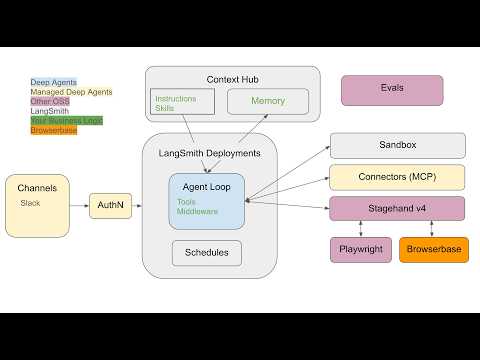
This stack addresses the 'last mile' problem in AI agent development: the gap between a prompt that works in a sandbox and a production service that can reliably navigate the web. By standardizing the harness (LangSmith), the interaction layer (Stagehand), and the infrastructure (Browserbase), it reduces the complexity of managing headless browser state at scale.
Strategic Implications
Standardizing on this architecture ties engineering teams closely to the LangSmith/Browserbase ecosystem. While this accelerates speed-to-market and simplifies maintenance, it also creates a platform dependency. Teams must weigh the benefit of 'all-in-one' tooling against the risk of vendor lock-in.
Evidence & Hype Audit
This is a promotional product demo. While the implementation shown works for the provided examples (ESPN and Hacker News), the video does not provide data on cost efficiency, concurrency limits, or error rates when encountering complex anti-bot measures. The 'production-grade' label is a claim, not an audited benchmark.
Counterarguments
Critics might argue that building on a managed stack limits the ability to optimize for edge cases, such as custom browser fingerprints or specific network-level bypasses that a bespoke Playwright implementation might handle more easily.
Who Should Care
- AI Engineers: Specifically those tasked with building reliable agentic automation.
- Product Managers: Those looking to shorten the cycle between prototyping a 'browsing agent' and deploying it to users.
What to Do Next
- Provision a LangSmith Plus account to enable Managed Deep Agents.
- Clone the integration repository to run a local test.
- Implement a robust snapshot-refresh logic loop to handle page changes.
- Configure Browserbase to capture full network logs for production sessions.
- Integrate an evaluation layer in the Context Hub to test prompt changes before full deployment.