
- Claude Code acts as a powerful, agentic 'harness' superior to general consumer-facing AI bots for business automation.
- An AI Operating System is a business methodology rather than a single software product.
- Centralizing data locally allows the AI to act as a 'co-CEO' that can perform SWOT analyses and identify growth trends.
- The shift from 'vibe coding' to structured agentic workflows represents a paradigm shift in how SME owners can scale.
- Managing a business via Telegram or mobile interfaces is becoming a realistic standard as agents gain more autonomous permissions.
- Automating inbox management and messaging saves significant time by summarizing or generating responses automatically.
- Internal tools, like the speaker's 'autoflow,' demonstrate how businesses can build proprietary logic on top of LLMs.
- High-impact automation should focus first on the tasks consuming the most energy from the business owner.
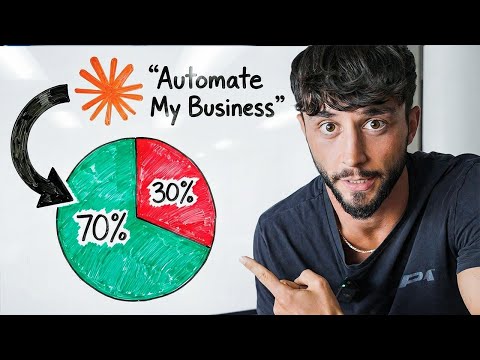
My Plan to Automate 70% of my Business w/ Claude Code (in 30 Days)
Liam Ottley
Key Takeaways
- Develop a centralized 'AIOS' to automate up to 70% of business tasks by layering intelligence over existing workflows.
- Utilize Claude Code as a base engine to build modular tools that handle data analysis, meeting intelligence, and project management.
- Implement a 'context-first' approach by creating a structured, local coding environment that serves as a single source of truth for your business data.
- Shift operations into a terminal or mobile interface to enable remote business management without requiring a dedicated development team.
Talking Points
Pro Analysis
The premise of an 'AIOS' is highly strategic and timely. As foundation models move from chat-based assistants to agentic workflows (like Anthropic’s Claude Code), the bottleneck for business owners isn't the AI's capability, but the lack of structured local data environments.
This is essential for leaders because it changes the 'buy versus build' dynamic. You no longer need a massive dev team to build internal software; an informed operator can now stitch together existing APIs and file systems.
Non-obvious takeaway: The most effective 'AI strategy' is currently data organization, not prompt engineering. If your business documentation is messy, the AI's efficacy will be limited regardless of how powerful the model is. The bottleneck is 'Context OS'—the work of cleaning and structuring your tribal knowledge into machine-readable formats.
Missing from the content is a discussion on risk mitigation, security (API key exposure), and the 'hallucination' risk of letting agents handle sensitive client communication. Future steps should focus on creating a robust 'human-in-the-loop' verification layer before full automation.
Time saved:
Written by: 1 Minute Signal Editorial Team