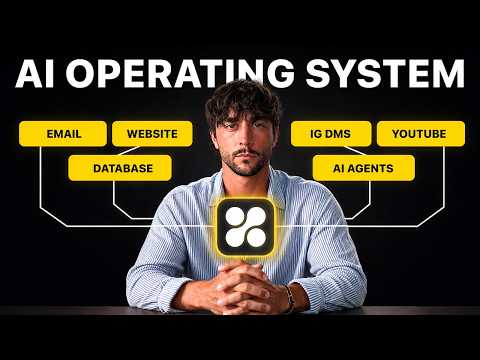
How to Build Your Own AI Agent Operating System (Ultimate Guide)

Video thumbnail: How to Build Your Own AI Agent Operating System (Ultimate Guide)
Aug 14, 202619m 26s video lengthLiam Ottley

The Signal

Productivity gains in business operations often stem from centralizing fragmented customer context, data, and tools into one unified AI workspace rather than adding standalone applications. By structuring trapped conversations—like Instagram DMs and form responses—into a searchable database, founders can surface overlooked opportunities and automate outreach without requiring heavy custom engineering or constant app-switching.

The Case

The Workflow

  • The narrator demonstrates a build sequence starting with a voice-captured context bank, moving to a centralized Supabase database that links event form responses and Instagram DMs by handle.1:10
  • This structure allows the AI to perform relational analysis on leads, such as surfacing a high-probability prospect's past applications and conversation history simultaneously.7:19
  • The workflow progression follows a manual-first approach: prove the logic as a manual 'skill' before wiring it to a webhook for autonomous agent-driven qualification.9:55

The Result

  • The narrator reports that using a 'good morning' skill to rank leads by a 'hotness score' helped a founder identify a dormant prospect who converted into a five-figure deal in under 24 hours.12:44
  • The system consolidates communication tools like Gmail and Meta within a Hyper Agent workspace, which the narrator claims saves up to 16 hours of manual re-entry and app-switching time per week.6:30
  • While the build demo is concrete, the broader claims regarding universal time savings, market-leading agent performance, and the superiority of this workspace over direct DIY coding in Claude Code remain anecdotal and asserted without independent benchmarks.5:13

The 1 Minute Signal Take

This system’s value lies in unlocking the 'trapped' data most businesses already possess but cannot effectively query. If you have significant inbound interest scattered across messaging platforms and spreadsheets, the primary leverage is not finding more leads, but centralizing the ones you already have.

Pro Analysis

Why It Matters

This content shifts the focus of AI implementation from 'more tools' to 'more integration.' By highlighting that business owners often lose money due to unworked leads rather than a lack of reach, it reframes the AI value proposition from lead generation to lead optimization.

Strategic Implications

The shift toward centralized 'agent operating systems' suggests that business productivity will increasingly depend on the quality of internal data architecture. Companies that can effectively index their own historical communications will gain a significant competitive advantage in conversion speed over those relying on manual triage.

Evidence & Hype Audit

  • Trustworthiness: The methodology—centralizing data and using relational links—is sound technical practice. However, the claimed time savings (16 hours/week) and the speed of the specific anecdote ($9,600 deal in 24 hours) are anecdotal and likely reflect 'best-case' outcomes.
  • Marketing Bias: The narrator promotes a specific platform (Hyper Agent) as an easier alternative to custom coding, which inherently introduces a bias toward platform lock-in.

Counterarguments

Critics might argue that building a centralized database requires more technical maintenance than a 'no-code' pitch suggests. Furthermore, privacy and security risks associated with aggregating sensitive DM and lead data into a third-party AI workspace are significant and were not addressed in the video.

Who Should Care

  • Founders: For those drowning in DMs and manually tracking leads, this provides a clear, high-level architecture for consolidation.
  • Operations Managers: Those interested in automating lead triage will find the webhook-trigger strategy highly relevant.

What To Do Next

  • Conduct a data audit to identify where lead history is currently fragmented.
  • Define the 'Hotness' criteria for your leads to inform future scoring logic.
  • Trial manual querying on your existing datasets before attempting to build autonomous agents.
  • Evaluate the security implications of aggregating customer data into a single AI-enabled environment.
Time saved:16m 24s

Share this

Tags

Written by: 1 Minute Signal Editorial Team