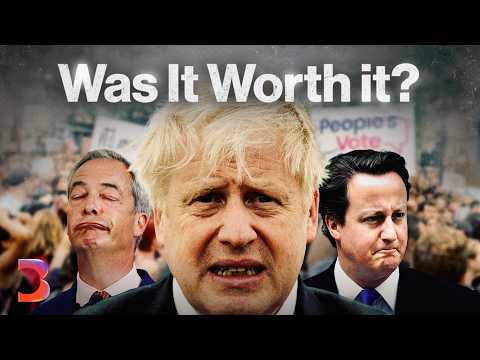
This Is What Brexit Cost the World

Video thumbnail: This Is What Brexit Cost the World
Jun 19, 202620m 51s video lengthBloomberg Originals

The Signal

Brexit, the 2016 UK referendum where 33 million voters chose to leave the European Union by a 52–48 margin, survives today less as a settled economic fact and more as a self-reinforcing engine of political instability. While proponents point to a democratic correction that forced the elite to acknowledge neglected grievances, the transcript characterizes the result as a 'blind Brexit' that delivered prolonged government turnover and a measurable 2–4% GDP loss while failing to fulfill promises of reduced immigration and control.

The Case

  • Brexit gave the UK a direction but no destination, leaving the country to struggle for nearly a decade over the missing alternative model for post-EU life.6:06
  • The economic impact, when measured against a counterfactual of 23 comparable OECD countries, remains a calculated drag of 2–4% of GDP after stripping out distortions like Ireland’s volatile data and US-led energy shocks.8:51
  • Political fragmentation reached historic heights with the UK cycling through five prime ministers since 2016, a sequence of churn that the transcript identifies as a more significant legacy than the economic hit.10:44
  • Immigration expectations were systematically betrayed; while EU-origin arrivals fell, record levels of non-EU migration caused total arrival numbers to climb, cementing a grievance cycle among voters who felt cheated.13:05
  • Certain sectors—specifically financial services, AI-related positioning, and VC funding—retained relative resilience, preventing the outcome from being an unambiguous economic collapse across every industry.9:43
  • The transcript frames Brexit as an early, potent tremor in a broader Western trend of nationalism and geopolitical fragmentation, where Britain now finds itself increasingly isolated from both the EU and a US that views the UK as a less vital strategic conduit.15:41

The 1 Minute Signal Take

This is a rigorous, sober assessment that successfully moves past the exhausted 'it was all a disaster' vs 'it was an act of sovereignty' binary to look at the wreckage of implementation. Skip the video if you want just the outcome data: the summary provides the entirety of the structural findings. Watch the video only if you want to observe how the speaker meticulously deconstructs the counter-intuitive performance of the UK services sector and the specific political exhaustion behind the leadership churn.

Pro Analysis

Strategic Significance

Brexit serves as the most prominent 21st-century study in how a democratic mandate based on emotional identity can collide with the harsh realities of governance, creating a decade of institutional drift.

Who Should Care

Political scientists, economists, and global leaders should study this as a masterclass in 'grievance-based' political design. It is essential for anyone interested in why modern democratic systems are struggling to deliver on simple, high-visibility campaign promises like border control or sovereignty.

Contrarian Takeaway

The most non-obvious insight is that Brexit may have been a necessary, if painful, pressure valve. By allowing the 'left-behind' voters to exert their will, it prevented a more violent or total system collapse, effectively acting as a diagnostic test for the limits of globalized political integration.

Time saved:18m 22s

Share this

Tags