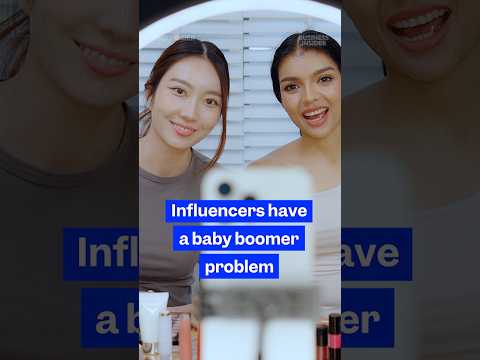
Why aren't #boomers buying what #influencers are selling? #marketing #brands #content

Video thumbnail: Why aren't #boomers buying what #influencers are selling? #marketing #brands #content
Oct 23, 20261m 30s video lengthBusiness Insider

The Signal

Influencer marketing is heavily skewed toward audiences aged 18–34, yet exclusive research shows this youth-obsessed strategy may be alienating a commercially vital demographic. Data reveals a stark trust gap and widespread annoyance among boomers, creating a significant disconnect between current advertising efforts and the segment responsible for 42% of spending in affluent US households.

The Case

Generational Trust Gap

  • Just 31% of boomers—people born between 1946 and 1964—trust influencer recommendations, compared to 62% of Gen Z and 64% of millennials.0:16
  • About a quarter of boomers report feeling annoyed by influencer content, suggesting a deeper aversion than simple skepticism, while younger cohorts generally find the material entertaining.

Strategic Misalignment

  • Advertisers disproportionately focus on the 18–34 age range, a bias that extends to the influencers they select for partnerships.0:35
  • Visa data from last year confirms that boomers represent 42% of spending among affluent US households, indicating that the industry’s youth-centric model may be overlooking a massive, high-spending audience.1:07

Alternative Creator Strategy

  • Experts argue that brands may be missing an opportunity by ignoring older influencers who cultivate huge, loyal fan bases.
  • Targeting boomer interest areas—specifically music, art, travel, and home improvement—through more relatable, age-appropriate creators may improve campaign performance.

The 1 Minute Signal Take

Marketers are currently chasing a youth demographic while neglecting a massive, affluent cohort that finds their primary strategy both untrustworthy and irritating. The data suggests that pivoting toward older influencers who provide relatable content is not just an untapped niche, but a necessary correction for brands looking to maintain long-term relevance.

Pro Analysis

Why It Matters

This is a story about a massive market inefficiency. Advertising logic has become decoupled from economic reality. By ignoring the preferences of the demographic holding nearly half of the affluent spending power, brands are not just losing engagement; they are leaving billions in potential revenue on the table due to a failure to localize content strategies for different age groups.

Strategic Implications

  • Resource Reallocation: Brands should conduct a portfolio analysis of their influencer spend to see if it mirrors their revenue streams or merely their internal biases toward youth culture.
  • Creator Diversification: The barrier to entry for older creators is likely lower than the saturated 'youth' creator space, offering a strategic advantage for brands that move first.

Evidence & Hype Audit

  • Trustworthy: The report relies on verifiable, commissioned research and credible economic data from Visa.
  • Limitations: The 'why' behind the trust gap is interpretive. The causal link between 'youth-obsessed advertising' and 'boomer annoyance' is a reasonable inference but not a controlled scientific finding. The piece functions more as an editorial nudge than a data-heavy white paper.

Counterarguments

  • Cost of Acquisition: Younger audiences may be cheaper to acquire via influencers, even if their lifetime value or spending power is currently lower.
  • Brand Longevity: Marketers might argue that targeting Gen Z is an investment in future lifetime value, not just current spending.

Who Should Care

  • CMOs: Need to rethink campaign performance metrics beyond raw reach.
  • Brand Strategists: Must develop new content pillars specific to the 50+ demographic.
  • Creator Agencies: Should expand their talent scouting to include mid-life and older influencers.

What to Do Next

  • Conduct a segment-specific audit of current influencer campaigns to measure trust and conversion by age.
  • Experiment with a pilot campaign featuring influencers over age 50 in a high-interest category.
  • Survey existing boomer customers to identify the specific content themes that resonate with them.
  • Challenge the '18–34' assumption in marketing briefs.

Share this

Tags

Written by: 1 Minute Signal Editorial Team