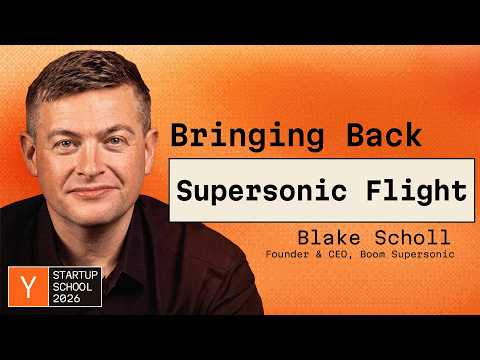
Blake Scholl: "The Future Was Supposed to Be Faster"

Video thumbnail: Blake Scholl: "The Future Was Supposed to Be Faster"
Jul 28, 202650m 2s video lengthY Combinator

The Signal

Boom Supersonic — a decade-old startup led by Blake Scholl — is attempting to revive civil supersonic travel by treating hardware development like software. Its primary proof point is the XB1 aircraft, which broke the sound barrier six times without creating a ground-level sonic boom, a milestone the company claims acted as a catalyst for a recent U.S. regulatory shift. The tension lies in whether this startup-centric, vertically integrated model can overcome the extreme capital and regulatory barriers that legacy aerospace giants like Boeing have historically failed to navigate profitably.

The Case

  • XB1 became the first independently developed jet to break the sound barrier, doing so six times across two flights without triggering an audible sonic boom at the ground.6:53
  • Boom claims this demonstration was a primary driver for an executive order and subsequent congressional legislation that legalized supersonic flight in the U.S. just 115 days later.10:30
  • To overcome the slow iteration cycles typical of legacy aerospace, Boom built "Makeboom" and "BladeRunner"—internal software tools that simulate aircraft and engine blade designs—and established an in-house machine shop that reduces prototype production to 24 hours.14:11
  • The company is financing its multi-billion-dollar R&D through "Superpower," a secondary product line that adapts its supersonic engine for ground-based natural gas power generation.17:32
  • Scholl claims that contrary to industry dogma, physical hardware startups can bypass years of legacy credentialing by building and proving performance directly, citing his own path from a software background at Amazon to aerospace leadership.5:31

Industrial Strategy

  • The company argues that the U.S. should not attempt to repatriate obsolete manufacturing but instead capture the next generation of industry through superior digital tooling, effectively eliminating the need for expensive, manual tool-and-die processes.21:45
  • Scholl advises founders to ignore the "why now" trap and prioritize tackling massive, overlooked problems rather than waiting for external market signals or perfect personal experience.20:02

The 1 Minute Signal Take

Boom’s progress demonstrates that high-stakes hardware can be accelerated by importing software-style continuous integration, yet the company remains unproven at the scale of a mass-market commercial airliner. While the XB1 proves the engineering and regulatory strategy is viable, the ultimate success of the Overture airliner depends on whether these internal efficiencies translate into durable, profitable airline economics.

Pro Analysis

Why It Matters

This content serves as a case study in 'Startup Hardware'—a category often dismissed by venture capital due to long feedback loops and heavy regulation. By proving that a 50-person team can influence federal policy through a concrete, physics-based demonstration, Scholl shifts the conversation from 'Why now?' to 'Why not?'

Strategic Implications

  1. Collaborative Regulation: Boom’s 'Boom plus FAA' strategy is a strategic pivot away from the adversarial model popularized by companies like early Uber. This suggests that for safety-critical industries, early transparency is the fastest path to market.
  2. Vertical Integration as a moat: By building a 'superfactory' rather than relying on the fragmented and slow aerospace supply chain, Boom creates a proprietary operational stack that traditional players (the 'legacy aerospace' culture) cannot easily replicate.

Evidence & Hype Audit

  • Strengths: The technical claims regarding XB1’s test flights and the subsequent timeline for executive action are on-record events. The description of internal tooling provides a logical mechanism for their claimed development speed.
  • Risks: The transition from a test prototype (XB1) to a full-scale airliner (Overture) remains a monumental hurdle. The economic viability of the 'Superpower' turbine as a financing engine is a future-oriented assertion rather than a demonstrated profit center.

Counterarguments

Critics might argue that Boeing and Lockheed’s slow development isn't just about 'obsolescence' but about a necessary focus on flight safety and institutional risk management that a startup, by definition, has not yet been stress-tested by. Furthermore, the 'supersonic passenger travel' market remains historically unproven and high-risk.

Who Should Care

  • Founders: Look at the 'Makeboom' tools as a model for how to build your own operational infrastructure.
  • Policy Wonks: Observe how a single technical demonstration can trigger rapid legislative movement when the goal is perceived as a non-partisan national interest.
  • Investors: Consider whether 'Superpower' type financing-workarounds are a new standard for high-capex hardware startups.

What To Do Next

  • Map your industry’s 'lost' progress: where has innovation stopped because people accepted current limits?
  • Identify if you can 'verticalize' a bottleneck in your own product development.
  • Practice 'confusion lists' in your own learning to stress-test your technical knowledge.
  • If in hardware, benchmark how long it takes you to make a physical iteration versus a digital one.
Time saved:46m 13s

Share this

Written by: 1 Minute Signal Editorial Team