
Channel: No Priors: AI, Machine Learning, Tech, & Startups
Biohub: The Future of Biology is Open-Source with Mark Zuckerberg, Priscilla Chan, and Alex Rives
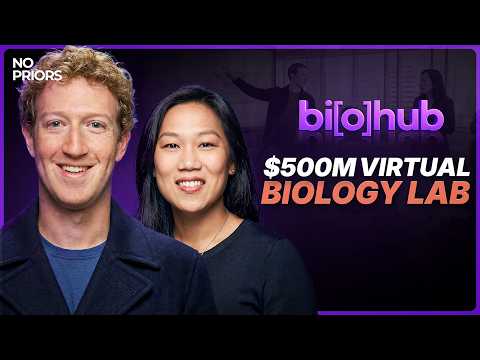
The Signal
The Chan Zuckerberg Initiative has pivoted its primary philanthropic strategy toward a $500 million 'virtual biology' initiative, prioritizing infrastructure over direct disease intervention. By coupling frontier AI with wet-lab capacity, leaders Mark Zuckerberg and Priscilla Chan aim to create hierarchical world models—moving from individual proteins to complete cellular systems—to accelerate the broader scientific community's ability to study biology and predict drug toxicity, while conceding that they are not directly curing diseases themselves.
The Case
- Biohub leads are building 'hierarchical world models'—starting with protein structures and aiming to eventually simulate whole cells and biological systems—to bridge the data gap in modern biology.
- The organization has structurally unified its AI researchers and life-science wet labs, asserting that AI is ineffective without the ability to physically invent new biological datasets.
- Alex Reeves, the Biohub research lead, reports that ESM Fold—an open-source general protein model trained on billions of sequences—accurately predicted 1.1 billion protein structures and spontaneously generated nanomolar binders, demonstrating emergent design capability.
- Leadership justifies the open-science strategy not as mere ideology, but as a mechanism for adoption, believing that putting tools into thousands of scientists' hands provides greater impact than centralized proprietary monetization.
- A specific near-term goal for translational medicine is using large-scale single-cell atlases to predict off-target toxicity before human trials begin, a high-cost failure point in current drug development.
- Despite these tool-building successes, executives explicitly distance the initiative from immediate clinical delivery, noting that navigating regulatory, safety, and clinical research hurdles remains a largely unresolved system problem.
The 1 Minute Signal Take
The Biohub model is a rare case where the scale of capital matches the ambition of the technical hardware and open-source goals, making their 'world model' roadmap a significantly more robust bet than typical biotech PR. While their clinical success remains aspirational and geographically distant, the ESM Fold results suggest they are successfully building the underlying physics engine for future drug discovery. Watch the video if you want the nuance of how they prioritize data generation over compute scaling, or if you care about the specific technical challenge of integrating wet-lab experiments into an AI-feedback loop.
Time saved:
Channel: No Priors: AI, Machine Learning, Tech, & Startups