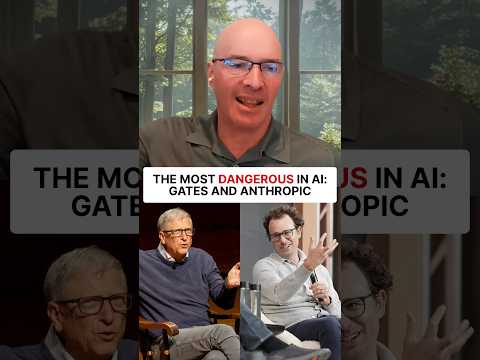
Ben Horowitz: “The most dangerous thing in AI is Anthropic and Bill Gates”

Video thumbnail: Ben Horowitz: “The most dangerous thing in AI is Anthropic and Bill Gates”
Oct 18, 20261m 12s video lengthAll-In Podcast

The Signal

The speaker argues that the current existential panic surrounding AI is premature because the technical conditions required for runaway recursive self-improvement have not been met. He warns that the narrative is being disproportionately amplified by highly credible figures like Bill Gates, whose political influence and historical track record as the founder of Microsoft lend undue weight to purely theoretical risk assessments.

The Case

  • The speaker defines the risk of a "runaway" AI as a process of recursive self-improvement that must satisfy four specific preconditions: each subsequent model must require fewer GPUs, take less training time, achieve better accuracy, and successfully repeat this cycle again and again.0:35
  • Asserting that "zero of those four" preconditions have been met, the speaker argues that the AI doom scenario remains an entirely theoretical prospect rather than an operational danger currently on the development track.0:59
  • The speaker claims that alarmist rhetoric about AI killing humanity is highly media-amplifiable, noting that anyone echoing this message can easily secure coverage on major news stations and in newspapers regardless of technical evidence.0:04
  • A central concern is that Bill Gates, a frequent political donor with significant influence specifically among the Democratic party, leverages his credibility to shape the public discourse around AI in ways that the speaker views as disproportionately alarmist.

The 1 Minute Signal Take

The speaker’s argument hinges on the technical assumption that recursive self-improvement requires an iterative cycle of efficiency that does not yet exist. By shifting the focus from the technology itself to the social mechanics of how high-status figures influence public policy, he identifies a credibility-driven feedback loop that may be more significant than the immediate risk of the models themselves.

Pro Analysis

Why It Matters

This content shifts the focus from the 'what' (AI capability) to the 'who' (the influence of high-credibility actors). It suggests that the current AI safety debate is significantly influenced by social signaling rather than engineering metrics, which can lead to premature or misguided regulation.

Strategic Implications

For investors and policymakers, this framework provides a sanity check. If one accepts the four-part test, resources should be allocated based on whether these specific performance-to-cost metrics are shifting, rather than responding to shifts in political rhetoric.

Evidence & Hype Audit

This content is highly skeptical of current hype cycles. However, it relies entirely on the speaker’s assertion that his four-point framework is the only valid way to measure risk. It lacks empirical data and assumes a specific, linear path for recursive improvement, which may not account for non-linear technical breakthroughs.

Counterarguments

Critics would argue that even if these four preconditions are not met, other pathways to risk—such as AI-enabled bioweapons, social manipulation, or automated cyberattacks—do not require recursive self-improvement to cause massive harm. The speaker’s narrow focus on runaway intelligence may ignore more immediate, albeit less 'Hollywood,' existential threats.

Who Should Care

  • Policy Makers: To distinguish between political noise and actual technical inflection points.
  • Investors: To avoid pricing in 'existential risk' when the engineering metrics do not support the narrative.
  • Media Critics: To observe how industry titans can act as force multipliers for alarmist sentiment.

What to Do Next

  • Monitor hardware and training-time trends relative to model performance.
  • Evaluate AI risk claims by asking which specific technical preconditions are being satisfied.
  • Question whether the source of an AI warning has credibility in fields outside of software engineering.
  • Map whether a proposed risk requires recursive self-improvement or if it can be achieved with current, non-self-improving systems.

Share this

Tags

Written by: 1 Minute Signal Editorial Team