
- Aman structures his new public vehicles as closed-end funds that behave like investment holding companies.
- The IPO strategy serves to invite retail investors into a structure that grants them interest in the management company.
- AI is positioned as a transformative technology that will generate value faster than any historical predecessor.
- The persistent belief that America's growth potential is infinite sustains Aman's bullish outlook despite inevitable market volatility.
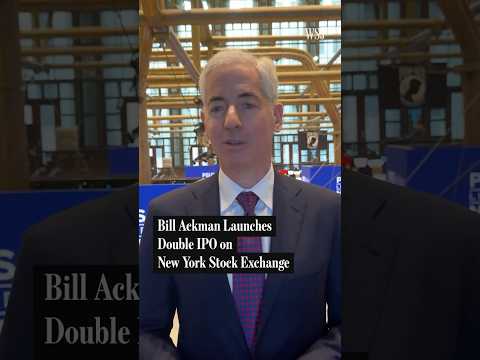
Bill Ackman Speaks With WSJ on Rare Double IPO and Stock Market Outlook | WSJ
The Wall Street Journal
Billionaire investor Bill Aman discusses the unconventional dual IPO of his holding companies and shares his bullish outlook on the American market and artificial intelligence.
Key Takeaways
- Bill Aman launched a unique dual IPO using a closed-end-fund wrapper that functions economically as an investment holding company.
- The offering includes a 'gift' feature where IPO investors receive an additional interest in the management company.
- Initial market reception was lukewarm, with shares falling up to 16% as retail participation failed to meet expectations.
Talking Points
Pro Analysis
Strategic Significance
This offering represents a rare attempt to standardize 'private equity-style' access for the retail market via a publicly traded wrapper. If successful, it could redefine how managers monetize their own firms; if it fails, it highlights the limits of retail appetite for complex financial structures.
Who Should Care
- Retail Investors: The offering is explicitly targeted at them, but they serve as the primary risk-bearers in the event of poor performance.
- Fund Managers: Observers of structural innovation in capital markets will closely track whether the 'management-interest-as-a-gift' model becomes a trend.
Contrarian Takeaway
The weak initial stock performance suggests that 'democratizing' equity through complex structures may actually confuse rather than attract the target audience, as the 16% drop proves retail apathy can override even the most high-profile sponsorship.
Time saved:
Written by: 1 Minute Signal Editorial Team