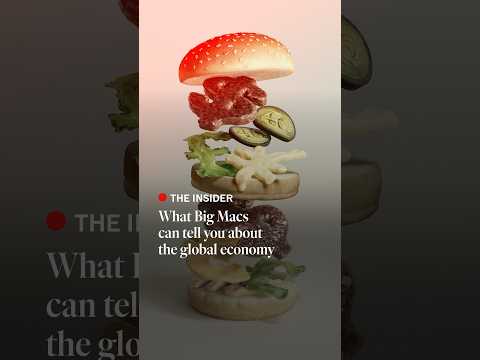
What Big Macs can tell you about the global economy | The Economist

Video thumbnail: What Big Macs can tell you about the global economy | The Economist
Jul 31, 20262m 50s video lengthThe Economist

The Signal

The Big Mac index is a proxy for purchasing-power parity (PPP), not a tool for short-term currency trading. While the index is a useful, standardized gauge of cross-country price differences, it is best applied to evaluating long-term local consumer wealth rather than predicting currency movements, which are generally unpredictable.

The Case

Origin and Mechanism

  • The index originated from a "bathtub moment" had by Pam Woodall, then an economics correspondent, after observing wide price disparities in European burger markets.
  • Analysts adopted the Big Mac as a universal purchasing-power standard because it is a standardized product that reflects local costs like labor and rent, alongside globally traded inputs.0:15
  • Switzerland is cited as one of the most expensive markets for a Big Mac, while Taiwan is one of the cheapest, illustrating the price divergence used to assess currency valuation.0:00

Utility and Limits

  • The index does not reliably predict short-term currency shifts, as market professionals would immediately arbitrage away any simple, publicly visible signal.1:45
  • While it lacks short-term predictive power, some observers suggest it acts as a weak signal for currency direction over a six-to-ten-year horizon.2:07
  • Investors find the index most valuable when analyzing foreign markets for consumer-facing businesses, such as a Korean clothing chain or casual-dining group, where understanding local household purchasing power is more important than tracking exchange rates.2:23

The 1 Minute Signal Take

The Big Mac index remains a practical analytical shorthand for comparing economic conditions across borders. Do not mistake its simplicity for a trading edge; its true utility lies in assessing the health and wealth of local consumer markets rather than forecasting currency moves.

Pro Analysis

Why It Matters

The Big Mac index represents a rare intersection where accessible pop-culture data meets foundational macroeconomic theory. By using a ubiquitous consumer good to illustrate purchasing-power parity (PPP), the index demystifies how economists think about currency valuation and wealth inequality.

Strategic Implications

For global businesses, the index serves as a sanity check for cost-of-living adjustments and local market entry strategies. It moves the conversation from abstract exchange rates to the concrete reality of what local labor and rent costs actually produce in terms of purchasing power.

Evidence & Hype Audit

The index is a descriptive tool, not a predictive model. The transcript correctly identifies that the index lacks the rigor of a formal trading algorithm. It relies on the consistency of McDonald's supply chain, which is a structural assumption that may not hold perfectly in all markets (e.g., ingredient substitution or local competition). The content is honest about these limitations.

Counterarguments

Critics argue that because the Big Mac is a non-traded good influenced heavily by corporate pricing strategy and local tax regimes, it is an imperfect proxy for currency value. One could argue that 'nontradable' costs (rent/labor) vary too much to make the index truly universal.

Role-Specific Takeaways

  • Investors: Use it to validate if local consumers have more 'real' money than current exchange rates suggest.
  • Economists: Use it as a communication tool for public engagement with PPP theory.
  • Strategists: Use it as an indicator for pricing parity when launching consumer brands in new regions.

What to do next

  • Audit your portfolio's exposure to regions where PPP suggests a significant currency undervaluation.
  • Compare local labor costs in your target market against the regional 'Big Mac' price to verify if the local consumer base is being priced out.
  • Analyze why a specific market might have a persistent price disparity (e.g., import tariffs, real estate bubbles).
  • Stop using the index for short-term FX trades; look toward interest rate differentials for that horizon.

Share this

Written by: 1 Minute Signal Editorial Team