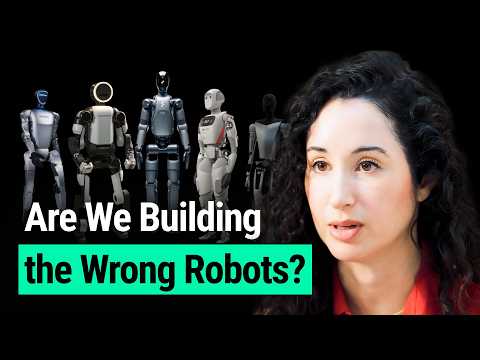
"ChatGPT Moment" for Robotics Is Coming. The Real Problem Isn't Intelligence | Stanford, Catie Cuan

Video thumbnail: "ChatGPT Moment" for Robotics Is Coming. The Real Problem Isn't Intelligence | Stanford, Catie Cuan
Jun 16, 202618m 51s video lengthEO

The Signal

Katie Quan, a roboticist and founder of Art Lab, contends that the current robotics industry is stagnating due to a myopic focus on humanoid, utility-driven machines. She argues that as robots move into shared human spaces, the field must prioritize legibility, emotional resonance, and safety, shifting the industry lens from simple labor replacement to human-centered creative interaction.

The Case

  • Quan frames the central challenge of robotics as "legibility"—ensuring machines and humans can safely understand one another's intentions in unpredictable, shared environments like hospitals or hotels.2:38
  • She points to her "music mode" project at Google—which mapped complex robot joint movements to musical sounds while robots performed mundane tasks—as evidence that expressive motion can radically improve human-robot relationships, with users reporting legitimate emotional connections to the machines.6:27
  • Drawing on a quote from roboticist Rodney Brooks, she argues that designing robots to look like humans is a "trap" because it triggers human mirror-neuron expectations that current machines cannot satisfy, leading to inevitable disappointment.9:23
  • Her personal catalyst is a story about her father’s hospitalization, where life-saving equipment felt terrifyingly opaque and alien to him, cementing her belief that technology must be designed to alleviate vulnerability rather than exacerbate it.5:32
  • Quan rejects the historical utility-only framework, pointing to examples like the Paro seal robot for therapeutic companionship and her own students’ work, to argue that robots should serve social and artistic roles.10:31
  • She shifts the burden of engineering from "what can I build?" to "why am I building it?" by teaching Stanford CS 334 students that because time is the only truly non-recoverable resource, robot creation should be anchored in explicit political or philosophical values.15:33
  • Her "VLI" (vision language interaction) model—which uses human context to drive robot behavior and evaluates success through human affect—is presented as a novel design paradigm, though the transcript provides no independent validation of its scalability or superiority.3:33

The 1 Minute Signal Take

Quan offers a compelling, humanistic counter-weight to the prevailing "humanoid-industrial complex" narrative, though she leans heavily on anecdotal evidence and self-promoted research to support her broad claims about the future of the field. Skip this video if you are looking for technical benchmarking; watch it for a masterclass in how to reframe dead-end engineering problems into meaningful, values-based design challenges.

Pro Analysis

Strategic Significance

This discourse represents a pivotal shift from roboticists as tool-builders to roboticists as designers of social...

Full analysis always available on Pro.

Time saved:16m 50s

Share this