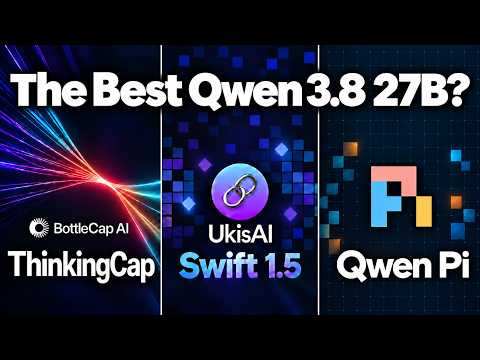
Which is The Best Qwen3.8-27B?

Video thumbnail: Which is The Best Qwen3.8-27B?
Oct 4, 202621m 19s video lengthSam Witteveen

The Signal

Qwen 3.8/27B offers adjustable reasoning effort, and three new fine-tunes now compete to shrink the model's thinking traces without sacrificing performance. The primary tension lies between generic token reduction and harness-specific optimization, as performance remains highly task-dependent. Choosing the right version requires matching your specific workload to the model's distinct training focus.

The Case

Model Specializations

  • Thinking Cap, built by Tomáš Mikolov’s Prague-based startup BottleCapAI, offers a conservative fine-tune that reduces thinking tokens by 37% across 12 benchmarks while keeping average accuracy nearly stable at 85.8%.1:18
  • Swift 1.5, created by Ukis AI, employs an aggressive strategy that penalizes specific 'overthinking' phrases like 'let me reconsider' before using reinforcement learning to optimize for long-horizon coding and agentic tasks.1:43
  • QwenPi is a specialized variant trained exclusively on successful sessions within the minimal Pi coding agent harness, achieving medium-effort performance that matches base models at x-high effort while using 41% fewer tokens.

Performance Nuances

  • Reasoning effort serves as a critical lever; lowering the default 'x-high' setting to 'medium' can cut inference time in half but often incurs an accuracy penalty of approximately nine percentage points.2:12
  • Live demos demonstrate that no single fine-tune dominates all tasks, with different models winning across math, logic, and SVG generation prompts depending on the specific input.
  • QwenPi’s current performance advantages are tied to the Pi harness, and its generalization to other coding environments remains unproven.14:34

The 1 Minute Signal Take

These models are not global replacements for the base Qwen 3.8 but rather specialized tools for different latency requirements. If you require general-purpose reasoning with conservative changes, start with Thinking Cap; for specialized agentic or coding workflows, evaluate Swift or QwenPi against your specific evaluation harness.

Pro Analysis

Why It Matters

The shift toward 'reasoning effort' control changes how developers deploy models. Rather than just selecting a base model, the future of inference is becoming a portfolio of 'effort-optimized' fine-tunes tailored to specific latency-to-intelligence ratios.

Strategic Implications

Businesses now face a 'specialization tax.' To get peak performance, companies may need to maintain different fine-tuned versions of the same base model for distinct use cases—an coding agent vs. a general knowledge bot. This favors developers who build highly modular systems capable of hot-swapping models based on the task type.

Evidence & Hype Audit

The content relies on reported benchmarks (LiveCodeBench, GPQA, TerminalBench) and live demos, which is highly trustworthy compared to vague marketing. However, the models are evaluated by their creators, and the '58.5% fewer tokens' claim from Swift should be treated as a best-case peak rather than a universal average.

Counterarguments

Critics might argue that these specialized fine-tunes are 'brittle.' By optimizing for specific benchmarks, these models may lose the serendipitous reasoning capability inherent in a base model’s wider training distribution.

Who Should Care

  • Inference Engineers: Evaluating cost-per-token and latency impacts.
  • Agent Framework Developers: Assessing whether harness-specific tuning (like QwenPi) is worth the overhead.
  • CTOs: Managing the trade-off between commercial licensing costs and performance gains.

What to Do Next

  • Benchmark candidate models using your specific production prompts.
  • Evaluate licensing terms against your revenue model.
  • Measure latency benefits in your actual vLLM deployment environment.
  • Test speculative decoding throughput with the target fine-tuned models.
Time saved:18m 34s

Share this

Written by: 1 Minute Signal Editorial Team