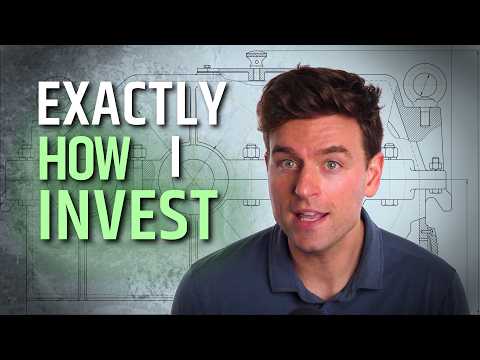
Breaking Down My Investment Portfolio

Video thumbnail: Breaking Down My Investment Portfolio
Oct 18, 202618m 57s video lengthBen Felix

The Signal

Ben Felix, a prominent wealth manager at PWL Capital, recently detailed his own personal investment portfolio to illustrate how evidence-based investing integrates with nonfinancial life goals. His strategy blends academic rigor in public markets with highly concentrated personal bets, explicitly rejecting the idea that wealth maximization is the sole metric for a good life.

The Case

Core Philosophy and History

  • Felix attributes his skepticism of wealth-driven happiness to growing up on elite boarding school campuses, where he observed that financial affluence often failed to prevent social and psychological distress in his peers.1:13
  • His career transition from selling actively managed mutual funds to evidence-based investing was catalyzed by reading academic literature, including Jensen's 1968 study, which demonstrated that active funds rarely beat passive portfolios after costs.7:31
  • He maintains that money is a tool for life-quality rather than an end; his investment decisions prioritize time, family stability, and psychological comfort alongside growth.10:21

Current Portfolio Mechanics

  • His public equity core consists of one Dimensional Global Equity Portfolio, a fund that replicates a total-market approach but includes intentional factor tilts toward smaller, more profitable, and lower-priced companies.10:45
  • He intentionally holds no bonds, citing a personal volatility tolerance supported by his ability to maintain flexible spending habits during deep market drawdowns.11:52
  • His most successful investment to date is a concentrated, direct equity stake in the firm One Digital, which acquired his employer PWL in 2025; he treats this as a personal, founder-like exception rather than a recommendation for others to concentrate assets in their own employers.12:48
  • He holds a significant cash buffer for psychological comfort and to cover unpredictable renovation costs, acknowledging the opportunity cost but prioritizing liquidity over strategic optimization.17:15
  • He classifies his home as a poor financial investment due to upkeep costs and opportunity loss, yet considers it the right decision for his family’s community and schooling needs.15:13

The 1 Minute Signal Take

Felix’s portfolio demonstrates that personal finance is fundamentally situational, requiring a deliberate balance between academic investment theory and the idiosyncratic risks of one’s own life. While his reliance on factor-based public funds is grounded in rigorous study, his willingness to hold concentrated employer equity and excess cash serves as a reminder that the "optimal" portfolio is the one you can personally sustain through the inevitable periods of underperformance.

Pro Analysis

Why It Matters

Felix’s reveal provides a crucial "steelman" for the argument that personal finance is not just math; it is a human-centric discipline. By showing the divergence between his client-facing advice and his own choices, he bridges the gap between academic theory and the lived experience of building wealth.

Strategic Implications

This narrative validates the idea of "portfolio flexibility." It suggests that once a foundational level of financial security is achieved through evidence-based assets, the rest of one's capital can be used to purchase specific outcomes—like stability, time, or the psychological buffer of cash.

Evidence & Hype Audit

Felix is highly transparent about his biases. He acknowledges the luck involved in his most successful investment and openly admits when his personal choices deviate from the optimal paths he recommends for clients. He relies on robust academic literature (Fama-French, Jensen) to anchor his core beliefs, making this one of the more trustworthy personal finance deep-dives available.

Counterarguments

Critics could argue that Felix’s "personal exception" for employer equity is a form of cognitive dissonance. While he characterizes his stake as a direct, productive contribution, it remains a highly idiosyncratic risk that would be catastrophic for a less-diversified investor. His defense essentially relies on his own competence and the firm's growth trajectory, which cannot be modeled by typical retail investors.

Who Should Care

  • DIY Investors: For those attempting to mimic his "evidence-based" style, to understand where they should diverge based on their own life goals.
  • Financial Advisors: To see how one manages the boundary between professional fiduciary duty and personal risk tolerance.

What to do next

  • Audit your own "irrational" financial decisions to see if they serve a non-financial goal like family stability.
  • Calculate the opportunity cost of your cash savings vs. the comfort they provide during volatile periods.
  • Reassess your bond allocation: determine if your flexibility in spending actually allows for higher equity exposure.
  • Document your "investment philosophy" to distinguish between standard market practice and personal exceptions.
Time saved:15m 17s

Share this

Tags

Written by: 1 Minute Signal Editorial Team