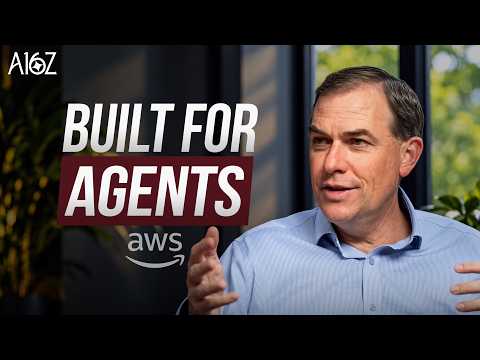
Building the Cloud for AI Agents | AWS CEO Matt Garman

Video thumbnail: Building the Cloud for AI Agents | AWS CEO Matt Garman
Oct 8, 202656m 18s video lengtha16z

The Signal

AWS is aggressively scaling its AI infrastructure, planning to acquire 2 million NVIDIA GPUs and commit $220 billion in capex for 2026. While demand from frontier labs is insatiable, AWS is intentionally prioritizing allocation for startups and enterprises to ensure ecosystem health, while simultaneously retooling its cloud platform to handle autonomous agentic workloads safely. The primary tension lies in bridging the gap between high-speed experimental agent deployments and the rigid trust, safety, and evaluation frameworks required by large-scale enterprise production environments.

The Case

Infrastructure and Capacity

  • AWS is managing a massive, multi-year supply chain and power buildout that extends up to 20 years into the future, as it no longer relies on utilities to meet capacity demands on demand.25:17
  • The company explicitly chooses to reserve capacity for startups and enterprises rather than selling its entire GPU supply to the largest frontier labs, viewing this as necessary for long-term ecosystem viability.0:29
  • Trainium 3—AWS’s custom AI accelerator—is currently sold out through the end of next year, with heavy adoption for both training and Bedrock inference workloads.37:52

Enterprise Agent Adoption

  • While enterprise interest is high, actual deployments remain largely human-in-the-loop because companies lack the evaluation, backtesting, and safety guardrails required to authorize fully autonomous agents in production.40:59
  • AWS is redesigning its onboarding flow to allow new accounts to be provisioned in under 30 seconds via Gmail, aiming to capture agentic and experimental traffic without forcing immediate architectural complexity.11:05
  • To address trust concerns, AWS markets Bedrock on the guarantee that enterprise data remains within the customer’s private VPC, ensuring it is not sent back to model providers.46:10

Organizational and Internal Impact

  • AWS reports that internal AI adoption, particularly the 'Quick' tool, has yielded the most measurable gains in software and product development, allowing teams to iterate faster with smaller headcounts.52:21
  • The company is actively experimenting with smaller, agent-managed 'pod' structures, moving away from traditional team designs to accommodate the increased velocity provided by AI-assisted coding and task automation.55:02

The 1 Minute Signal Take

Enterprise AI adoption is currently bottlenecked by a lack of rigorous evaluation infrastructure rather than model capability alone. AWS's strategy focuses on being the 'safe' infrastructure provider, betting that companies will ultimately prioritize their data governance and internal control primitives over pure frontier-model capability.

Pro Analysis

Why It Matters

AWS is shifting from a general-purpose utility provider to an active orchestrator of the agentic revolution. By controlling the infrastructure layer—the chips, the power, and the security boundaries—AWS is attempting to steer the enterprise AI market toward a future where it remains the indispensable platform.

Strategic Implications

AWS’s strategy of intentional capacity allocation and long-range power planning suggests a move toward sovereign infrastructure management. The company is no longer waiting for utilities or supply chains to catch up; it is actively shaping the market's physical constraints.

Evidence & Hype Audit

While the narrative is technically grounded in AWS's own product evolution, the claims regarding 'agentic workflows performing better on AWS' and the 'popularity of Continuum' are self-reported and lack independent benchmarks. Investors should view the 'early stages' framing as a standard corporate effort to maintain a growth narrative despite massive scale.

Counterarguments

Critics might argue that AWS’s push into agent-native primitives risks creating vendor lock-in that makes moving workloads to other clouds prohibitively expensive. Furthermore, the reliance on proprietary chips like Trainium could fail if the industry converges on standard-hardware compatibility more rapidly than AWS anticipates.

Who Should Care

  • CTOs/CIOs: Focused on the 'trust' blocker for agent adoption.
  • Infrastructure Leads: Monitoring the shift from human-managed to agent-managed security and permissioning.
  • Startup Founders: Assessing whether AWS will prioritize their capacity requests during upcoming GPU bottlenecks.

What to Do Next

  • Conduct a gap analysis of your current CI/CD pipelines to see where agentic parallelism can replace human-in-the-loop steps.
  • Review current data governance policies to ensure agent access does not violate VPC isolation boundaries.
  • Pilot small, sandboxed agent tasks using Firecracker-based infrastructure to test security guardrails.
  • Evaluate the ROI of fine-tuning open-weights models versus using frontier APIs for specialized enterprise tasks.
Time saved:52m 47s

Share this

Tags

Written by: 1 Minute Signal Editorial Team