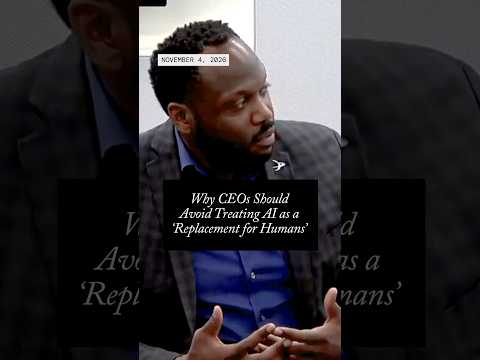
Why CEOs Should Avoid Treating AI as a ‘True Replacement for Humans’

Video thumbnail: Why CEOs Should Avoid Treating AI as a ‘True Replacement for Humans’
Nov 10, 20261m 31s video lengthCouncil on Foreign Relations

The Signal

Organizational decision-makers are increasingly firing staff and developers just two months after adopting AI, driven by the belief that "vibe coding"—an informal, AI-reliant approach to development—can replace professional expertise. While acknowledging the utility of commercial LLMs for productivity, the speaker warns that using these tools as a total substitute for human labor creates significant IT security and privacy risks.

The Case

The Shift Toward Replacement

  • The speaker reports a consistent pattern among advised CEOs who rapidly downsize departments, often shedding both general staff and technical developers shortly after AI adoption.0:10
  • Leaders frequently justify these layoffs by claiming they can simply "vibe code" their way to the same outcomes without human headcount.
  • These layoffs appear to be based on an assumption that AI acts as a total functional equivalent to employees rather than an augmenting tool.0:46

The Risks of Substitution

  • Vibe coding—portrayed as a risky substitute for rigorous engineering—is identified as a potential vector for serious IT security and privacy failures when human oversight is removed.0:31
  • The speaker argues that AI should be treated strictly as an "additional tool" in the toolbox, emphasizing that they use LLMs personally while rejecting them as a true replacement for human beings.1:09
  • The underlying tension lies in the trade-off between the perceived short-term economic gains of downsizing and the long-term operational fragility introduced by relying on automated systems without human verification.

The 1 Minute Signal Take

AI is currently being used as a justification for preemptive layoffs, but relying on "vibe coding" to replace technical staff creates operational risks that remain largely unaddressed. Organizations prioritizing these short-term cost savings may be overestimating AI's capability while creating significant, hidden security and privacy liabilities.

Pro Analysis

Why it Matters

This content captures a pivotal moment in the 'AI hype cycle' where executive overconfidence meets operational reality. It highlights a critical disconnect between the perceived capabilities of LLMs and the actual expertise required to build secure, sustainable technical infrastructure.

Strategic Implications

For organizations, the primary risk is 'knowledge erosion.' By firing staff based on initial AI performance, companies are destroying their institutional memory and ability to debug the very systems they are now building with AI. This creates a fragile dependency where the organization is locked into a 'black box' workflow they no longer fully understand.

Evidence & Hype Audit

This content is high-signal but anecdotal. The lack of specific data (company names, failure rates, audit reports) suggests this is an 'expert's observation' rather than a peer-reviewed study. However, the mechanism—over-trusting AI for complex tasks—is a known behavioral pattern in technology adoption. It should be viewed as a warning from the front lines, not as definitive research.

Counterarguments

Critics of the 'teaming' approach might argue that for early-stage startups or non-critical internal tools, the speed of 'vibe coding' is a legitimate competitive advantage that justifies the risk. In these environments, the cost of being wrong is lower than the cost of slow development.

Who Should Care

  • CTOs/Engineers: To resist impulsive downsizing and maintain technical standards.
  • CEOs/Founders: To avoid the trap of mistaking AI output speed for long-term viability.
  • HR/Operations: To audit whether layoffs are leaving the company vulnerable to security and compliance gaps.

What to Do Next

  • Conduct a 'security audit' on all codebases generated or heavily influenced by AI.
  • Map which roles are currently being replaced and evaluate if the oversight function has been adequately backfilled.
  • Implement a 'human-in-the-loop' policy for all critical infrastructure deployment.
  • Set a 90-day review period for any department currently operating primarily on AI-generated workflows.
  • Redefine AI as a productivity 'assistant' in official company documentation, not a 'replacement' for human roles.

Share this

Tags

Written by: 1 Minute Signal Editorial Team