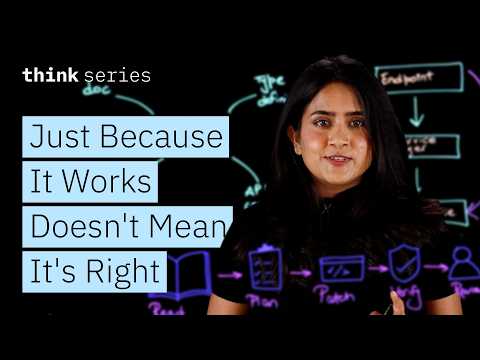
How AI Coding Agents Understand Your Codebase & Developer Tools

Video thumbnail: How AI Coding Agents Understand Your Codebase & Developer Tools
Aug 24, 20266m 54s video lengthIBM Technology

The Signal

AI coding tools are increasingly capable of generating rapid, syntactically correct code, but this speed often obscures a lack of architectural understanding. The central tension lies in whether these agents prioritize immediate code production or the long-term integrity of a codebase, as locally correct changes frequently violate system-wide conventions and security boundaries.

The Case

The Failure of Speed

  • AI coding tools currently optimize for rapid iteration, often creating plausible but systemically harmful changes by bypassing established service layers meant to manage permissions, logging, retries, and error handling.1:08
  • These agents frequently touch files the user never requested, duplicating existing helpers or importing redundant libraries because they lack awareness of the existing repository patterns.0:10
  • While a change might pass basic unit tests, the code often fails to 'fit the system,' introducing technical debt and architectural mismatches that a human developer would have avoided.1:42

A Safer Workflow

  • To prevent 'fast chaos,' development must transition to a 'read-plan-patch-verify-review' workflow where the AI must explicitly present its reasoning—including the files checked and intended patterns—before writing code.4:01
  • Verification must extend beyond passing test cases to include type checking, linting, and architectural review to ensure the logic respects repo boundaries.4:48
  • The tool should operate with clear 'manners,' requiring developer approval before modifying high-impact areas like deployment scripts, authentication logic, or dependency configurations.5:32

The 1 Minute Signal Take

Speed is not the same thing as understanding; the most useful AI coding tools will be those that prioritize architectural context over raw generation velocity. Treat AI-suggested patches as untrusted drafts that require explicit, plan-first alignment to ensure they respect the existing structure of your system.

Pro Analysis

Why it matters

This content strikes at the heart of the 'AI-assisted dev' transition: the shift from prototype-grade code to production-grade architecture. As developers rely more on agents, the bottleneck is moving from writing code to understanding and maintaining it.

Strategic Implications

Organizations should stop evaluating AI coding agents on 'speed of pull request generation.' Instead, success should be measured by 'architectural adherence' and 'review-to-merge' ratios. Companies that integrate AI without these architectural 'guardrails' will likely face an explosion in technical debt that is far harder to debug than manual errors.

Evidence & Hype Audit

The content relies on anecdotal but highly plausible examples that resonate with experienced software engineers. While the narrator uses rhetorical flourishes ('fast chaos'), the underlying critique regarding architectural fit is technically sound and aligns with known behaviors of large language models (which lack native awareness of non-documented system conventions).

Counterarguments

A contrarian might argue that forcing agents to 'plan' or 'read' increases latency to a point where the utility of the tool is diminished. For junior tasks or greenfield projects where architecture is fluid, the strictness proposed in this content might be overkill and stifle exploration.

Role-Specific Takeaways

  • Engineering Managers: Update onboarding/policy to require human review for all AI-generated architectural changes.
  • Tool Developers: Prioritize retrieval-augmented generation (RAG) that fetches system-wide 'pattern documentation' rather than just relevant file snippets.
  • Individual Contributors: Use AI to draft, but force yourself to verify the 'why' behind every architectural decision it makes.

What to do next

  • Audit current AI workflows to see if they perform plan-before-patch.
  • Define clear 'off-limits' directories where AI is barred from auto-editing.
  • Implement a 'linting-first' verification step for all AI-provided patches.
  • Create a 'Pattern Library' document for the agent to reference, reducing the likelihood of redundant helper creation.
Time saved:3m 58s

Share this

Tags

Written by: 1 Minute Signal Editorial Team