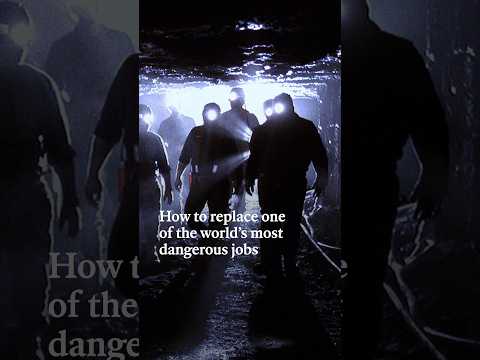
How to replace one of the world's most dangerous jobs | The Economist

Video thumbnail: How to replace one of the world's most dangerous jobs | The Economist
Sep 16, 20262m 4s video lengthThe Economist

The Signal

An open-pit coal mine in China serves as a live test case for industrial autonomy, where a fleet of 100 autonomous electric trucks operates continuously to replace human labor in hazardous conditions. The shift highlights how firms like Huawei are pivoting toward industrial AI to recover from significant revenue losses under American sanctions.

The Case

  • The mine has transitioned labor away from the pit, with 120 workers reassigned to other roles as autonomous trucks handle the hauling.0:24
  • Operational endurance is the primary advantage; the trucks operate throughout the night and perform automated battery swaps on site without human intervention.0:55
  • The system architecture decouples hardware from software: the physical trucks are manufactured by an unnamed state-owned Chinese company, while the autonomous driving stack is provided by Huawei.1:11
  • Huawei is diversifying its business model after 2021 American sanctions caused a nearly 30% drop in revenue, forcing the telecom giant to aggressively pursue sales outside its traditional customer base.1:31
  • The narrator positions this mine as a frontier for autonomous vehicle technology, suggesting that harsh, remote industrial environments offer clearer benefits than better-known consumer applications like robot taxis.
  • Whether the mine's success is broadly representative of industrial autonomy and if most humans will actually disappear from the pit within three years remain unproven forecasts.

The 1 Minute Signal Take

This deployment demonstrates a clear industrial pivot toward autonomy to solve labor exposure in dangerous settings, distinct from the hype surrounding consumer-facing robotaxis. Huawei’s involvement confirms that its post-sanction strategy relies on applying high-tech stacks to legacy infrastructure to rebuild lost revenue streams.

Pro Analysis

Why It Matters

The transition of autonomous technology from consumer curiosities to heavy industrial workhorses highlights a shift where the value proposition is defined by safety and endurance rather than convenience. The human cost of mining makes this a uniquely defensible and economically rational deployment of AI.

Strategic Implications

This case demonstrates how technological giants, when constrained by geopolitics (sanctions), will aggressively move into 'boring' industrial sectors where their tech stack can offer high-margin, sticky solutions. It signals that the future of autonomy may be written in mines and factories, not on public streets.

Evidence & Hype Audit

The content is high-signal, relying on observable metrics (100 trucks, 120 workers, 30% revenue drop). However, it remains a showcase of a single site; the claim that this is the 'clearest' application of autonomy is an editorial framing rather than a proven universal law.

Counterarguments

Critics might argue that such rapid displacement of labor, while 'safer,' creates massive structural unemployment issues that are not addressed in the video. Additionally, dependency on a single software provider (Huawei) creates new types of 'vendor lock-in' that could be riskier than human operational reliance.

Who Should Care

  • Labor Unions & Policy Makers: To understand the speed at which industrial AI can eliminate on-site jobs.
  • Tech Strategists: To see how companies pivot business models under intense regulatory pressure.
  • Industrial Investors: To benchmark the ROI of autonomous vs. manual mine operations.

What to Do Next

  • Audit existing high-hazard workflows for potential autonomous replacement.
  • Review the supply chain reliance of internal AI initiatives to ensure modularity.
  • Analyze the long-term cost-benefit of robotic maintenance systems (like battery swapping) versus human-serviced equipment.

Share this

Tags

Written by: 1 Minute Signal Editorial Team