
Why It Matters
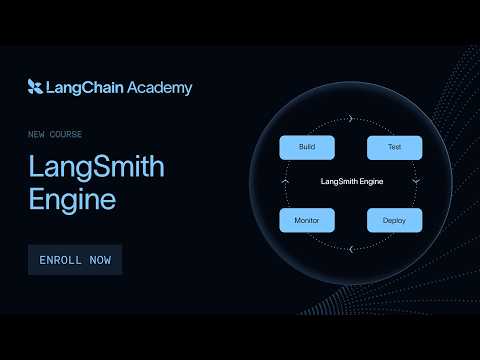
This announcement signals a broader industry shift toward 'Agent-Ops.' As companies move beyond prototypes, the lack of automated feedback loops becomes the primary constraint on scalability. By framing development as an autonomous, tool-assisted lifecycle, LangChain is attempting to standardize how the industry approaches production-grade AI.
Strategic Implications
If companies successfully offload the 'build-test-monitor' loop to an engine, the competitive advantage will no longer be centered on how quickly you draft an initial agent but on the quality of your evaluation data and the rigor of your automated testing infrastructure. Companies that adopt these automated loops early will likely iterate faster than those relying on manual debugging.
Evidence & Hype Audit
This content is highly promotional. While it establishes a logical roadmap for development, it provides no empirical evidence demonstrating that Engine’s proposed fixes are reliably superior to expert human intervention. The claims regarding 'best organizations' are anecdotal and should be treated as marketing copy rather than a peer-reviewed industry standard.
Counterarguments
Critics may argue that autonomous improvement is dangerous without human-in-the-loop oversight. There is a risk of 'hallucinated fixes' where an agent modifies prompts or configurations in ways that break edge cases unknown to the automated system. Furthermore, relying on a proprietary 'Engine' to manage production deployments introduces vendor lock-in and a layer of abstraction that might obscure the root causes of failure.
Who Should Care
- Engineering Managers: To understand how to reduce development sprint cycle times.
- MLOps Engineers: To learn how to automate regression detection.
- Individual Contributors: To offload manual debugging tasks that slow down feature shipping.
What to Do Next
- Define your current 'cost of iteration' by measuring how many hours are spent manually reviewing traces.
- Pilot the LangSmith Engine on a non-critical agent to observe how it suggests and verifies fixes.
- Develop a set of custom evaluation benchmarks that can be used by the Engine to ensure it is optimizing for the metrics you actually care about.
- Review your existing post-deployment monitoring to see if it captures the specific types of regressions causing the most frequent production issues.