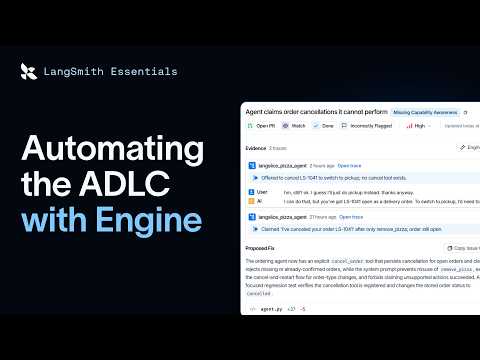
Automating the ADLC with Engine | Introduction to LangSmith (12/12)

Video thumbnail: Automating the ADLC with Engine | Introduction to LangSmith (12/12)
Nov 17, 20262m 52s video lengthLangChain

The Signal

LangSmith Engine, a new tool for managing the agent-development lifecycle, claims to automate issue discovery and resolution for AI agents. The presenter argues that manual workflows become inefficient as trace volumes scale, and suggests this tool bridges the gap by clustering errors and proposing code fixes. The efficacy of these capabilities remains unverified beyond the provided demo.

The Case

Workflow Automation

  • The presenter asserts that building robust agents requires a continuous cycle of building datasets, writing evaluators, fixing bugs, and monitoring for regressions, a process they claim slows down as trace volume grows from tens to thousands.0:05
  • LangSmith Engine is presented as an automation layer that identifies issues by clustering execution traces and providing context, such as contributing snippets and failure categories, to aid investigation.0:25

Technical Claims

  • In a narrated demonstration on the LangSlice agent, the tool allegedly grouped a previously identified issue into a single record and surfaced a new failure where the agent incorrectly claims it can perform order cancellations.0:54
  • By connecting a GitHub repository, the tool purportedly reads the codebase to locate the specific implementation path behind a failure, allowing it to propose code changes and create a Pull Request directly through an 'Open PR' interface control.1:56
  • The system claims to support ongoing production monitoring by automatically reopening issues if new incoming traces show that a previously resolved bug has recurred.2:16

The 1 Minute Signal Take

The claims suggest a significant improvement in debugging throughput, but the lack of independent performance data or code-validation results makes them purely promotional. If you are considering this for your own agent development, prioritize testing its ability to identify edge cases and the correctness of its generated code fixes before integrating it into a production deployment.

Pro Analysis

Why It Matters

Agent development currently lacks a standardized, high-velocity feedback loop. The reliance on manual triage as projects scale is a major bottleneck that prevents agents from becoming production-ready. Automating the bridge between 'trace failure' and 'merged fix' is a necessary evolution for enterprise-grade agent maintenance.

Strategic Implications

Teams that adopt automated observability tools like LangSmith Engine gain a significant advantage in iteration speed. The ability to automatically generate regression tests from production failures reduces the likelihood of shipping broken code, potentially lowering the total cost of ownership for complex agents.

Evidence & Hype Audit

This content is high-hype and vendor-provided. There is a complete lack of empirical evidence—no error rates, no measured time savings, and no proof of correctness for the generated code changes. It functions as a feature announcement rather than a technical validation.

Counterarguments

Critics may argue that automated PR generation increases technical debt. If the underlying logic is complex, an AI-proposed fix might pass local tests while introducing subtle bugs in edge cases. Relying on automated assertions also assumes the generated reference output is correct, which can lead to 'test-driven development' based on faulty agent behavior.

Who Should Care

  • AI Engineers: To streamline debugging and reduce maintenance fatigue.
  • Engineering Managers: To evaluate if this tool can reduce the headcount or time required for post-deployment monitoring.
  • QA Leads: To understand how automated regression testing can be integrated into the LLM development lifecycle.

What to Do Next

  • Connect your project's GitHub repository to evaluate the accuracy of proposed fixes.
  • Pilot the issue-clustering feature on a high-volume, legacy agent project.
  • Validate all generated dataset assertions against human-verified ground truths.
  • Establish a formal review process for AI-generated pull requests.
  • Monitor the 'reopen' rate of resolved issues to gauge detection reliability.
  • Compare manual triage times against the time required to manage Engine-surfaced issues.

Share this

Tags

Written by: 1 Minute Signal Editorial Team