
Why It Matters
This approach signals a shift toward 'agent-driven development,' where the developer's role moves from writing syntax to managing high-level orchestration layers. By packaging complexity into 'skills,' Google is effectively turning documentation into actionable capabilities, which significantly lowers the barrier to entry for building robust, production-ready AI agents.
Strategic Implications
Businesses now face a choice between the rapid iteration provided by coding-agent SDKs and the long-term efficiency of traditional frameworks. The trend indicates that as agent complexity grows, enterprise-grade tooling that offers observability (tracing) and security (sandboxing) will become the differentiator that separates hobbyist projects from durable, scalable platforms.
Evidence & Hype Audit
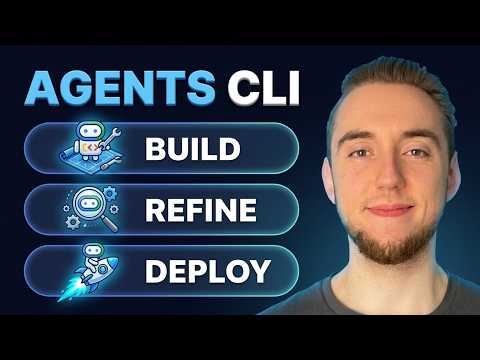
- Strengths: The demo clearly shows a successful end-to-end workflow (install, build, eval, deploy). The focus on production observability features is grounded in real-world infrastructure needs.
- Weaknesses: The claims regarding developer productivity and the '4-second abandonment rule' are presented as industry facts but lack specific citations. The assertion that this workflow scales to 'millions of users' is an aspirational claim unsupported by load-testing evidence in the video.
Counterarguments
- Vendor Lock-in: The heavy reliance on Google’s Agent CLI and ADK ecosystems potentially creates significant platform lock-in, which may not suit teams prioritizing multi-cloud portability.
- Abstraction Costs: Hiding installation and deployment behind 'skills' can lead to 'black box' development, where engineers struggle to debug underlying environment issues when the automation inevitably fails.
Who Should Care
- Technical Leads: To evaluate if this CLI workflow can standardize team deployment cycles.
- Product Owners: To understand how to align agentic features with performance requirements like low latency.
- Platform Engineers: To assess if the observability tools offered by GCP's Agent deployment meet enterprise audit requirements.
What To Do Next
- Conduct a pilot build by installing the Agent CLI in a non-critical side project to test the skill-loading capability.
- Map current agent deployments to see where manual tasks can be replaced with CLI-equivalent skills.
- Develop a standard evaluation test set for existing agents to identify performance regressions.
- Evaluate the current latency of your agentic workflows against the 4-second engagement threshold.
- Implement a sandbox for code-executing components if relying on third-party libraries.