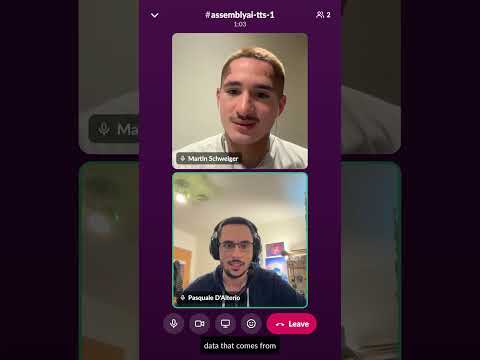
What makes text-to-speech sound natural?

Video thumbnail: What makes text-to-speech sound natural?
Nov 5, 20261m 51s video lengthAssemblyAI

The Signal

Assembly AI is positioning its new TTS1 text-to-speech model as a shift toward conversational authenticity. Rather than aiming for polished, professional narration, the team intends to mimic the pacing and tone of a natural person on a phone call, marking a clear product tradeoff that prioritizes human-like interaction over scripted perfection.

The Case

Research Strategy

  • The team defines "naturalness" as speech that mirrors the spontaneity of a live conversation, explicitly contrasting this against the style of audiobooks or professional voice-over work.0:24
  • Pasquali, the lead researcher on the project, acknowledges that measuring this quality is inherently difficult and proposes a proxy method: comparing the model's prosody—the rhythm and intonation of speech—against data from real human conversations.1:01

Roadmap Priorities

  • Scaling breadth is the immediate focus, with language expansion currently holding the highest priority on the development roadmap.1:19
  • Beyond initial language support, the team is actively working to incorporate contextual information from previous dialogue turns into the generation process to ensure prosody remains aligned with the ongoing conversation.
  • The transcript stops short of providing concrete implementation details, such as a specific release timeline for new languages, an operationalized metric for naturalness, or evidence that the proposed context-aware generation is currently functional.1:44

The 1 Minute Signal Take

Assembly AI is betting that the next leap in synthetic speech isn't just audio quality, but social intelligence. By focusing on conversational prosody and turn-based context, they are attempting to solve for the "uncanny valley" of robotic pacing, though they have yet to prove these methods with standardized, objective benchmarks.

Pro Analysis

Why It Matters

The pivot toward 'conversational' TTS represents a fundamental shift in how we conceive of AI interfaces. Moving from a 'presentation' model (reading text) to a 'dialogue' model (participating in a call) changes the threshold for what users accept as high quality.

Strategic Implications

By prioritizing language expansion, Assembly AI is signaling an aggressive push for market share in the global communication space. The focus on context-aware prosody is an attempt to solve the 'uncanny valley' of speech, where a voice sounds perfect but feels contextually awkward.

Evidence & Hype Audit

This content is largely promotional. While the technical goals (context-aware prosody) are sound research objectives, there is no performance data or evaluation evidence provided in the transcript to confirm that their current implementation effectively meets these targets.

Counterarguments

Critics might argue that 'naturalness' is too subjective to be a meaningful KPI. By prioritizing conversational feel over polished, professional audio, the model might struggle in use cases where clarity, authority, and consistent tone are required (e.g., automated support or legal notices).

Role-Specific Takeaways

  • Product Managers: Evaluate how 'conversational' the model feels in your specific use case; it may not be a one-size-fits-all improvement.
  • Researchers: Look into prosody-based evaluation techniques as a potential industry standard for conversational AI.

What To Do Next

  • Compare TTS1 output against professional narration to test if the 'conversational' focus works for your brand.
  • Monitor Assembly AI's update logs for the release of their expanded language library.
  • Investigate how your team handles conversational state, as future API updates may require sending historical turn data for better prosody.

Share this

Written by: 1 Minute Signal Editorial Team