
Strategic Significance
The shift away from mandatory vector database usage signals a maturation of the AI infrastructure stack. Early adoption was driven by novelty; current engineering decisions are increasingly governed by total cost of ownership and operational overhead. This transition highlights a move toward 'right-sized' infrastructure where the retrieval layer is determined by the data's semantic density rather than industry trends.
Hype vs. Evidence
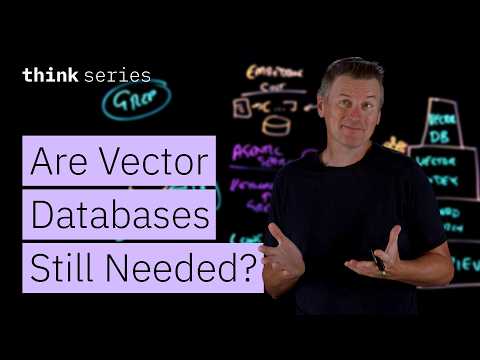
This content is highly trustworthy and grounded in functional architecture. It avoids vendor bias and actively discourages the 'add everything' mentality common in the current AI hype cycle. The speaker provides logical bounds (the 'pyramid') that allow engineers to test their assumptions against clear, objective thresholds.
Counterarguments
Critics might argue that the 'long-context' approach is inherently slower and more expensive due to input token costs, and that dedicated vector databases offer superior developer experience (DX) and tooling. For some teams, the convenience of a purpose-built vector DB outweighs the operational cost of managing a multi-modal general-purpose database.
Action Items
- Profile your current retrieval latency to see if you are truly bottlenecked.
- Perform a 'gap analysis' by running a set of representative queries against both a keyword-based agent and a vector index to quantify the semantic match improvement.
- Calculate the total cost of your embedding pipeline, including re-embedding overhead.
- Consolidate your stack by evaluating if your primary database’s existing vector index can replace a secondary dedicated system.
- Pilot a long-context-only approach for your next small-to-medium project to verify performance stability.
- Map your document set size against current model token limits to identify potential 'context-fit' candidates.