
- The 'super-agent' trope creates security vulnerabilities and increases the likelihood of rogue behavior.
- Emphasize high cohesion: each agent should have one specific task and zero unnecessary privileges.
- Collaboration between multiple specialized agents is superior to single, all-encompassing agents.
- The risk/capability matrix helps identify which systems need human-in-the-loop oversight.
- Determine agent lifecycles based on risk: use persistent agents for low-risk tasks and ephemeral agents for high-risk, non-deterministic tasks.
- Apply dynamic access controls for agents that use reasoning vs. static credentials for simple automated functions.
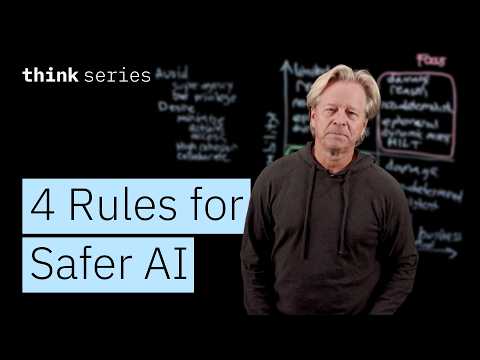
4 Ways AI Agents Should Behave for Smarter Systems
IBM Technology
This presentation explores the necessity of moving away from hazardous 'super-agent' designs toward safer, collaborative agentic systems. It provides a strategic framework for categorizing these agents based on their capability levels and risk profiles to ensure secure, controlled performance.
Key Takeaways
- Shift from the 'super-agent' model to collaborative systems where small, specialized agents work together to complete tasks.
- Implement the principle of high cohesion, ensuring agents have the minimum necessary access and limited action sets required for their specific function.
- Categorize agents using a four-quadrant matrix based on risk and capability to determine the appropriate security controls and operational design.
- Utilize ephemeral lifecycles and dynamic access management for high-capability, high-risk agents to minimize exposure.
Talking Points
Pro Analysis
This framework is strategically important because it shifts the conversation from 'what AI can do' to 'how to govern what AI does.' As enterprises move from RAG (Retrieval Augmented Generation) to true agentic workflows, the potential for catastrophic failure (e.g., executing unauthorized financial transactions) increases significantly.
This is vital for IT architects, CTOs, and Security Operations teams who must balance the productivity gains of autonomous agents with the mandates of enterprise data governance.
A Non-Obvious Takeaway: While traditional security relies on static, long-lived credentials for system accounts, the speaker implies that high-capability AI agents require the exact opposite: ephemeral, context-aware identities. The most advanced systems shouldn't have 'permanent' access; they should be 'born' with specific permissions, perform their task, and 'die' before they can be hijacked, effectively treating the agent's existence as a finite security event.
Time saved:
Written by: 1 Minute Signal Editorial Team