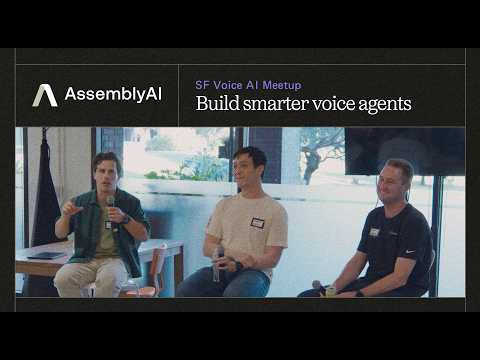
Build Smarter Voice Agents

Video thumbnail: Build Smarter Voice Agents
Jul 28, 202646m 14s video lengthAssemblyAI

The Signal

Voice infrastructure builders at Retail AI and Super converge on a clear consensus: quality depends far less on individual model performance than on modular architecture and persistent user context. While developers often chase monolithic speech-to-speech models, the reality of production—where providers fail and context loss infuriates users—favors a deconstructed approach that allows for fallback routing and reliable memory.

The Case

Architectural Strategy

  • Both firms reject monolithic “magic models” in favor of cascading pipelines—separating ASR, LLM, and TTS—to maintain granular control over latency, provider swappability, and fallback routing.1:22
  • Retail AI reports that ~99% of its agents use this modular stack, asserting that the ability to route around unhealthy provider APIs is a critical moat in production environments.

The User Experience

  • Memory and personalization are the dominant factors for quality; Super reports ~95% negative sentiment when users must repeat information already provided in a previous turn.14:56
  • Super employs a "scratchpad" to build customer profiles in parallel to the conversation, while Retail AI uses CRM-integrated persistence to ensure agents recognize returning users.15:45
  • Naturalness remains partly subjective, leaving human "vibe checks" as a necessary evaluation standard alongside quantitative metrics for transcription accuracy and response latency.8:37

Scaling and Reliability

  • The industry-standard latency budget is tight, targeting 1–1.5 seconds; responsiveness under one second can paradoxically feel unnerving to human callers.4:34
  • Production resilience remains the primary challenge, as demos often mask the realities of signal degradation and edge-case noise that cause simple systems to break.18:08
  • Cost management requires identifying high-spend areas like reasoning tokens; speakers suggest that lowering reasoning capacity or using older models can often achieve performance parity with less overhead.25:24

The 1 Minute Signal Take

Engineering a production-grade voice agent is a problem of reliability and state management, not just model intelligence. If you are building, prioritize a modular stack that makes moving parts replaceable and invest heavily in a dedicated memory layer, as users will forgive a slightly simpler model but will rarely tolerate a system that forgets who they are.

Pro Analysis

Why It Matters

As voice interfaces move from demos to enterprise deployment, the focus is shifting from 'can it talk?' to 'can it be trusted under load?' The shift from monolithic models to modular, testable stacks marks the professionalization of the field.

Strategic Implications

The modularity favored by the panelists indicates that proprietary, all-in-one voice models face significant competition from 'composer' platforms that allow companies to mix and match best-in-breed providers. This favors infrastructure players who can provide sophisticated routing and fallback logic over companies banking solely on model superiority.

Evidence & Hype Audit

This content is high-signal for practitioners but carries some internal bias. The speakers' preference for cascading architectures reflects the needs of platform providers rather than the ideal end-state for smaller, resource-constrained builders. The '95% negative sentiment' statistic is anecdotal and likely reflects highly specific user-testing conditions, not universal human psychology.

Counterarguments

The panel advocates for cascading pipelines, but the technical debt and latency costs of maintaining three separate API hops (ASR + LLM + TTS) are non-trivial. Proponents of native S2S models argue that end-to-end training can eventually capture emotional nuances and prosody that modular systems miss by treating text as an intermediary.

Who Should Care

  • Product Leads: You need to decide if latency or accuracy is your primary selling point.
  • Backend Engineers: Reliability through routing is your primary moat.
  • Founders: Your cost structure will be determined by how well you filter reasoning needs.

What to do next

  • Audit your latency budget and identify the specific node causing the most drag.
  • Build a secondary provider routing layer for your ASR and TTS components.
  • Implement a 'scratchpad' memory structure to store user profile data.
  • Define clear 'vibe check' categories for your TTS quality and formalize them for human reviewers.
  • Run a cost analysis on your reasoning token usage to see if lower-level models meet your vertical needs.
Time saved:42m 54s

Share this

Tags

Written by: 1 Minute Signal Editorial Team