
- Financial markets are fundamentally broken by redundant intermediaries, which adds friction and extracts value from end-users.
- Extreme technical talent is currently misallocated into zero-sum HFT strategies because the compensation structure creates a barrier to meaningful innovation.
- Moving beyond money-focused optimization to long-term impact requires rejecting the 'golden handcuffs' of high-frequency trading firms.
- Building a 24/7 global exchange necessitates rigorous, real-time risk management that goes far beyond typical application-level error handling.
Back to Feed
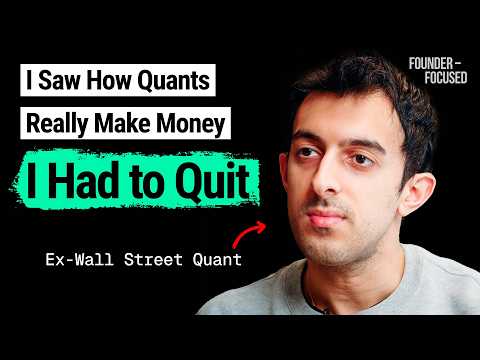
This Ex-Quant Had to Quit Wall Street to Build a 24/7 Stock Exchange | QFEX, Annanay Kapila
The video discusses the transition of a former high-frequency trading quant into a fintech founder building a more efficient, transparent global stock exchange model. It examines the ethical shift from optimizing market extraction to engineering better, user-centric market design.
Key Takeaways
- Traditional market infrastructure relies on unnecessary layers—brokers, dealers, and clearinghouses—that extract value from investors through friction and hidden costs.
- The current incentive structure of quantitative finance, dominated by 'golden handcuffs' and massive bonuses, traps high-value technical talent in zero-sum industries instead of systemic innovation.
- A resilient 24/7 exchange requires treating uptime and reliability as the core product, moving beyond simple execution to robust, self-correcting settlement systems.
Talking Points
Analysis
This content is strategically valuable for anyone interested in the intersection of market design and technical infrastructure. The speaker provides a rare look at the 'dark side' of HFT—not from an external critique, but from the inside, identifying how talent is misallocated at elite technical institutions.
Who should care?
- Software Engineers: The move from quant strategies to exchange architecture highlights a shift in engineering challenges from predictive modeling to high-availability, consistent, distributed systems.
- Fintech Founders: The insight that 'financial markets don't reward 10 million-dollar businesses' warns potential founders about the binary, high-stakes nature of exchange-level infrastructure.
Contrarian Takeaway: The speaker argues that current regulatory and intermediary frameworks are the primary drivers of HFT profitability. The disruption, therefore, isn't just about faster execution, but about removing the necessity of the intermediaries that make the current, flawed model essential.
Time saved:
Back to Feed