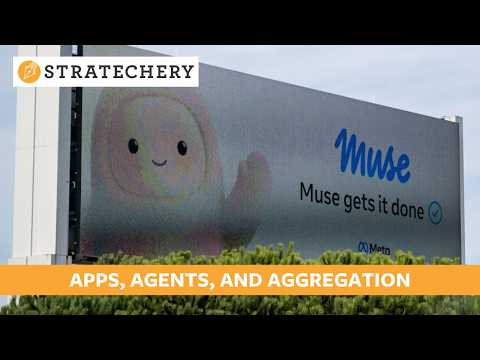
Apps, Agents, and Aggregation | Stratechery by Ben Thompson

Video thumbnail: Apps, Agents, and Aggregation | Stratechery by Ben Thompson
Oct 6, 202617m 39s video lengthStratechery

The Signal

The central tension in computing is shifting from app-centric interaction to agent-centric execution. The speaker argues that the next major platform gatekeepers will be the companies that provide agents capable of both acting on a user's behalf and dynamically generating the user interface, effectively turning the 'app era' into a legacy model.

The Case

The Shift to Agent-Mediated UI

  • The speaker frames the current state of AI as analogous to the iPhone launch, where the most revolutionary capability—internet communications—was initially misunderstood by observers.2:02
  • Agents are being redefined as AIs with independent access to a deterministic computer, such as Meta’s Muse, which provides every user a virtual machine with a 2-core CPU, 8 GB of RAM, and 8 GB of storage.6:17
  • This 'packaged computer' approach is presented as the only viable path to making agent-based task completion accessible to mainstream users who cannot manage their own infrastructure.7:07
  • The 'infinite app' concept suggests that instead of navigating hundreds of fixed-purpose apps, users will rely on agents to generate custom, disposable UI on demand for specific jobs, such as organizing saved Instagram recipes.9:15

Enterprise and Consumer Gatekeepers

  • Microsoft is positioning Copilot as an 'OS for work' by embedding agents directly into the enterprise tenant, where they gain internal identity, memory, and access to governed workflows in Teams, Outlook, and documents.13:58
  • Meta is positioned as the primary consumer agent layer because it combines massive global reach with social context, using its hardware as a delivery vehicle for these personalized agent experiences.10:31
  • The core economic thesis is that aggregation theory is shifting: because task execution is becoming abundant, the new bottleneck is 'volition' or inspiration—deciding what should be done.11:43

Market and Conceptual Disputes

  • While the speaker contends that conventional apps are destined to feel 'odd' and 'barbaric' compared to natural language interfaces, this remains a prediction rather than an established market reality.16:00
  • The claim that most people or companies will settle on only 'one agent' is a forward-looking assertion that has yet to be tested against the fragmentation of platforms.17:07
  • The speaker’s own workflow serves as the primary evidence for app-abundance, noting that while he keeps 689 apps on his phone, he rarely opens most of them, favoring a few core communication and task-oriented services.5:26

The 1 Minute Signal Take

The transition to agent-centric computing represents a move away from human-navigated app ecosystems toward platforms that manage intent and execute outcomes. Success will likely be determined not by the models themselves, but by which companies can successfully leverage their existing distribution to own the 'OS for work' or the 'OS for life.'

Pro Analysis

Why It Matters

The shift from apps to agents represents a fundamental decoupling of service delivery from the user interface. By abstracting the UI, platform owners effectively turn every SaaS provider into a mere 'backend' for the agent, stripping away the visual branding and retention mechanisms that businesses have relied on for decades.

Strategic Implications

Businesses must prepare for a future where their software is consumed via API calls rather than human clicks. The 'aggregator' of the agent era will be the platform that best interprets human intent, meaning companies that own the 'customer relationship' at the agent level will dictate the economic terms for all downstream services.

Evidence & Hype Audit

This content is a high-level strategic synthesis rather than a technical report. While the speaker provides concrete anecdotes (like the recipe app), the broad claims about the 'death of apps' are predictive and rely on a specific interpretation of Aggregation Theory. It is highly informed but inherently biased toward the thesis that distribution and context are the only durable advantages.

Counterarguments

Critics might argue that agent reliability, rate-limiting (as noted with Instagram), and security concerns will maintain the need for human-in-the-loop interfaces for the foreseeable future. Furthermore, the 'one agent per user' vision may be hindered by platform silos that prevent a single agent from effectively acting across disparate ecosystems.

Who Should Care

  • Product Leaders: To understand if their UI is a feature or a liability.
  • Enterprise IT: To evaluate the security and governance implications of agent-mediated workflows.
  • Investors: To identify which platforms hold the distribution leverage to become the primary 'intent' gatekeeper.

What to Do Next

  • Audit your product's API surface area; if it isn't agent-ready, prioritize it.
  • Evaluate how your organization might shift from 'selling UI' to 'providing outcomes' to an agent-gatekeeper.
  • Test early agent frameworks to understand their current limitations in cross-app orchestration.
  • Define the specific 'jobs to be done' that your product serves to ensure agent compatibility.
Time saved:13m 43s

Share this

Tags

Written by: 1 Minute Signal Editorial Team