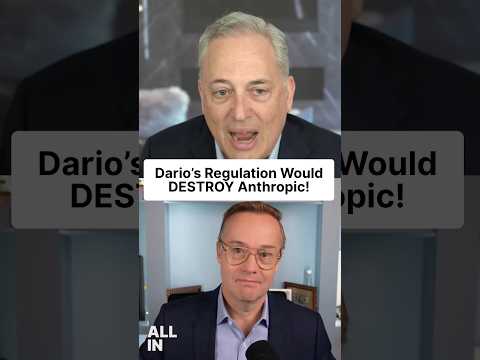
David Sacks: If Dario Got His Way on AI Regulation, It Would Destroy Anthropic

Video thumbnail: David Sacks: If Dario Got His Way on AI Regulation, It Would Destroy Anthropic
Aug 25, 20261m 32s video lengthAll-In Podcast

The Signal

Anthropic—an AI lab founded by Dario Amodei that advocates for an FAA-style regulatory apparatus for AI—may be pursuing a strategy that undermines its own business. The core tension lies in Anthropic’s reliance on maintaining a six-month lead over open models to justify premium token pricing, a lead that critics argue would evaporate under the five-year certification cycles typical of federal aviation oversight.

The Case

Strategic Tension

  • Dario Amodei, the chief executive of Anthropic, has publicly lobbied for an FAA-like approval framework, yet this policy goal reportedly conflicts with the company's own economic model.0:02
  • The speaker argues that Anthropic and its rival OpenAI are trapped on a "hamster wheel," needing to stay ahead of open-source competitors to maintain the "massive premium" they charge for frontier intelligence.1:25
  • If a mandatory pre-release approval process were implemented, the inevitable administrative delay would commoditize these frontier models before they even reached the market, effectively erasing the firm's competitive edge.

Competitive Impact

  • Federal airframe certification takes a minimum of five years, a timeline that is presented as fundamentally incompatible with the rapid iterative pace of AI model releases.0:36
  • The analysis warns that slowing domestic model releases through such regulation would allow Chinese competitors to close the capability gap, harming U.S. strategic interests in the global AI race.0:53
  • Because the business case for an "hugely successful" IPO depends on maintaining this frontier lead, the speaker suggests that achieving the regulatory "dream" Dario advocates would ultimately diminish the company's valuation.

The 1 Minute Signal Take

Regulatory safety frameworks that prioritize oversight over speed may inadvertently destroy the commercial viability of frontier AI firms that rely on a fleeting "lead-time" advantage. The speaker highlights a genuine contradiction: the very regulation desired by AI leadership could render their specialized, high-margin product models obsolete by forcing them into a slow, bureaucratic deployment cycle.

Pro Analysis

The Competitive Dilemma

This content highlights a fundamental clash between safety-focused regulation and the fast-cycle economics of the AI industry. The argument hinges on the idea that AI-as-a-service is a perishable good; its value derives from being 'new and better' rather than 'stable and verified.'

Strategic Implications

If policy moves toward an FAA-like model, companies will likely pivot their strategy toward long-term deployment features (like enterprise integration or proprietary data moats) rather than raw model-performance leads. Conversely, if the regulatory climate shifts to 'lighter' touch, we can expect a continued, relentless drive toward model scaling at any cost.

Evidence & Hype Audit

This content is highly analytical but reflects the speaker's specific viewpoint. It lacks empirical data on how an 'FAA for AI' would actually function, relying instead on an analogy between aircraft airframes and software model weights. The '6-month' lead estimate is an assertion, not an audited business metric, and should be treated as a strategic estimate rather than a proven fact.

Counterarguments

The counter-position is that without centralized regulation, the risks of catastrophic AI failure increase exponentially. Proponents argue that a slower, safer release cycle is a feature—not a bug—of a responsible industry, and that market valuation should adapt to a world where AI safety is a baseline requirement, not a competitive differentiator.

Who Should Care

  • Investors: Should assess whether an AI company's valuation is tied to sustainable moats or just a transient performance lead.
  • Policy Makers: Must weigh the tradeoff between mitigating existential risk and maintaining technical sovereignty.
  • Founders: Must decide whether to push for 'regulatory capture' to keep small competitors out, or to push for speed to preserve their own market share.

Share this

Tags

Written by: 1 Minute Signal Editorial Team