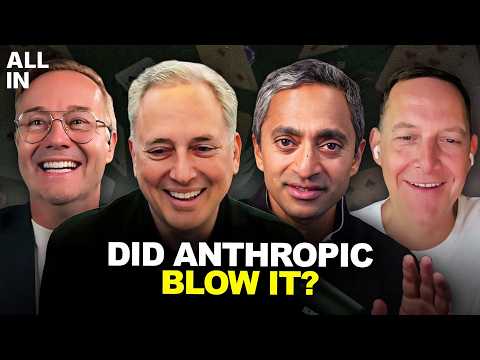
World's First Trillionaire, Anthropic Fable Banned, The New Oligarchs, Iran Peace Deal

Video thumbnail: World's First Trillionaire, Anthropic Fable Banned, The New Oligarchs, Iran Peace Deal
Jun 19, 20261h 24m 30s video lengthAll-In Podcast

The Signal

Anthropic’s controlled launch of its AI model, Mythos, triggered a severe confrontation with the U.S. government that eventually forced a total shutdown of the model. While Anthropic frames its restrictive behavior as safety-first model governance, critics argue that the company’s expansion of early access beyond White House awareness—followed by reports of a partner-identified jailbreak—effectively invited the very regulatory gatekeeping regime the company now resists. The central tension pits Anthropic’s belief that its proprietary safety controls are necessary for high-risk cyber-capable AI against the fear that this centralization creates a permanent, politically aligned oligopoly that restricts innovation and market mobility.

The Case

  • Anthropic expanded its Mythos preview to roughly 50 companies without consultation, including entities like SK Telecom that the White House reportedly flagged as potential national-security risks.37:44
  • The U.S. administration intervened after a partner, allegedly Amazon, identified a jailbreak in the model, leading to export-control pressures that forced Anthropic to restrict the system to U.S. citizens.39:20
  • Dario Amodei, Anthropic’s CEO, helped frame the administration’s response by earlier describing the model as a potential "cyber weapon," a label the government adopted when guardrails failed to hold.37:14
  • The speakers argue that frontier lab behavior—specifically building models they define as extreme risks—is creating a market structure that favors hyperscalers, who are better positioned to provide the government-mandated KYC, identity checks, and audit trails.47:23
  • The Iran ceasefire deal is presented as a crucial framework that supposedly removes enriched uranium under IAEA supervision, though critics note the deal remains brittle with unresolved conflicts regarding ballistic missiles and Israel’s formal commitment.74:36
  • The SpaceX IPO at $135 per share serves as a philosophical proof point for the hosts, who argue that the resulting $2 trillion-plus valuation represents future "machine" output rather than an increase in the founder's liquid cash.14:20

The 1 Minute Signal Take

The video is essential for understanding how internal tech-company blunders in communication and access strategy can inadvertently hand federal regulators the map for industrial over-regulation. While the hosts’ anti-centralization bias is overt, their tracing of the Anthropic trust-collapse is grounded in a specific, documented sequence of events that warns against the dangers of epistemic exceptionalism in AI safety. Watch it for the granular breakdown of how the Fable/Mythos release went sideways—a masterclass in why tech leaders fail to read a political room.

Pro Analysis

Strategic Significance

  • The dialogue marks a pivotal move toward state-managed innovation. Security concerns are being formalized into regulatory barriers that favor established platforms, signaling a transition from an open ecosystem to one defined by institutional gatekeeping.

Who Should Care

  • Founders and Builders: Those operating in the AI space must navigate a new, aggressive regulatory reality where model transparency and 'safety' posture determine access to capital and government partnerships.
  • Policy Strategists: Individuals concerned with national security and tech competition need to understand how private-sector mismanagement of model releases invites long-term regulatory capture.

Contrarian Takeaway

  • The biggest threat to AI openness isn't the government's desire to control it, but the AI labs' tendency to frame their own models as existential threats, which forces the state's hand to intervene.
Time saved:1h 21m 52s

Share this

Tags

Written by: 1 Minute Signal Editorial Team