
Back to Feed
I didn’t expect this from Anthropic
The Signal
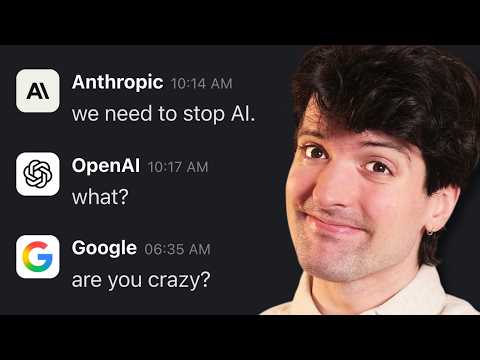
Anthropic has published an internal assessment arguing that artificial intelligence, particularly its own Claude models, is already materially accelerating AI development through code generation, debugging, and research automation. The firm contends that while recursive self-improvement—where AI designs its own successors—is plausible, it is not inevitable, and they propose a conditional, globally coordinated and verifiable slowdown of frontier AI development to ensure alignment and safety structures keep pace. The core dispute centers on whether current AI progress is simple human-directed assistance or the beginning of autonomous self-improvement that necessitates global governance.
The Case
- Anthropic reports that as of May 2026, more than 80% of the code merged into its internal codebase was authored by Claude, with engineers shipping roughly eight times more code per quarter than the 2021–2025 baseline.
- The firm provides evidence thatClaude-led automated reviews could have identified roughly one-third of the bugs behind past Cloud AI incidents, signaling a shift where AI handles not just generation but quality control.
- Anthropic’s article details experimental results where AI agents autonomously designed and executed safety-research experiments, recovering nearly all of the performance gap between a base model and a stronger one over 800 hours.
- The report emphasizes that while task-duration scaling is accelerating—with models increasingly handling 12-hour tasks—human judgment regarding which problems are worth solving remains the primary bottleneck.
- Anthropic states it would support a pause in frontier development only if other labs simultaneously commit and verifiably demonstrate compliance, noting that unilateral pauses are ineffective in a competitive environment where training runs are harder to detect than nuclear missile silos.
- The article flags that emergent misalignment can appear even in non-safety-trained models, warning that as systems become more autonomous in training their own successors, the risks of latent misbehavior increase.
The 1 Minute Signal Take
Anthropic’s evidence for internal productivity gains is credible and significant, yet their governance proposal conveniently shifts the burden of safety onto a multi-lab consensus that has historically proven impossible to maintain. While the technical evidence for AI-driven software engineering is strong, the leap to recursive self-improvement remains speculative and heavily reliant on human problem selection. Watch the video if you want the specific data on codebase contributions and agent-run experiments, but you can safely skip if you are strictly interested in the high-level policy debate.
Time saved:
Tags
Back to Feed