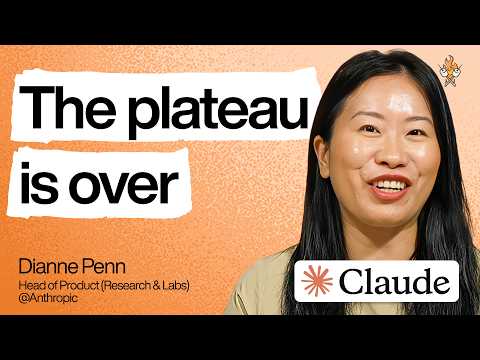
Anthropic’s first technical PM on token maxing, the jagged edge, and living in the future

Video thumbnail: Anthropic’s first technical PM on token maxing, the jagged edge, and living in the future
Jul 26, 20261h 33m 51s video lengthLenny's Podcast

The Signal

Anthropic has successfully pivoted from a culture-heavy research startup to a product-led powerhouse by replacing traditional PRDs with 'evals' as their primary planning artifact. This shift forces researchers and product managers to treat model capabilities as measurable data rather than abstract theory, allowing the company to rapidly ship models like Opus 3 and 4.5 in lock-step with frontier product features.

The Case

Operational Shift

  • Anthropic managers reject standard PRDs for model-centric work, opting instead to build 'evals' that convert vague user complaints into actionable, reproducible success metrics. This process, internally summarized as 'evals are the new PRDs,' allowed the team to fix early instruction-following failures by identifying that roughly 80% of issues were actually simple JSON schema errors.0:53
  • The company’s product velocity is driven by deep alignment between model training and product surface; for instance, the Opus 4.5 model series required the development of Claude Code to make its frontier capabilities usable. This suggests that without the corresponding product vehicle, model advancements alone may fail to deliver meaningful user-facing impact.0:31

Culture and Talent

  • Anthropic maintains its 'startup-like' culture through a hiring and management model that requires all levels of seniority to be hands-on with the models. Even senior managers receive the same onboarding as junior hires, ensuring leadership retains a 'theory of mind' regarding current model strengths and rough edges.5:10
  • Small 'Labs' pods are utilized for discontinuous, zero-to-one bets like Claude Design and MCP, allowing the company to keep the core roadmap focused while maintaining a portfolio of high-upside prototypes that can be deferred or launched based on model evolution.23:57

Model Utility

  • The internal operating philosophy holds that Claude is most useful when it is forced to disagree; researchers design alignment to ensure the model pushes back on pricing decisions or flawed reasoning rather than blindly complying. This is presented as a strategic benefit, transforming AI from a passive drafting tool into a constructive 'thinking partner' that coaches users through difficult conversations.65:31

The 1 Minute Signal Take

Anthropic’s model for success demonstrates that in the AI era, true product leadership is less about defining long-term feature roadmaps and more about establishing high-fidelity measurement loops. Readers should note that for organizations working with non-deterministic models, the competitive edge lies in the speed at which vague user frustration is transformed into concrete, testable evaluative data.

Pro Analysis

Why It Matters

The transition from PRDs to evals represents a fundamental maturation of the AI industry. It signals that we have moved past the era where 'AI magic' was enough to win market share. Companies are now optimizing for predictability, reliability, and specific task-based performance.

Strategic Implications

Anthropic is positioning itself as a system-integrated provider rather than a raw API provider. By creating 'frontier products' like Claude Code alongside models, they are capturing the entire value chain of agentic workflows. This creates a feedback loop that competitors relying on external developer ecosystems may struggle to match.

Evidence & Hype Audit

The narrative is high-quality, operational, and grounded in specific examples (e.g., JSON handling). However, it is inherently pro-Anthropic. The claims regarding 'discontinuous' scaling laws vs. smooth loss curves are industry standards but Anthropic clearly emphasizes its ability to 'detect' these jumps early as a unique skill.

Counterarguments

The heavy focus on 'evals as PRDs' is labor-intensive. It requires a high baseline of human oversight that may not scale across all industries. Furthermore, the reliance on internal 'Labs' culture can lead to fragmented product ecosystems if not managed rigorously during growth.

Role-Specific Takeaways

  • For Founders: Shift your hiring toward people who tinker. If your product leaders aren't using the API personally, fire them.
  • For Product Managers: Stop writing feature requirements. Start writing automated eval benchmarks.

What to do next

  • Audit your biggest product user complaints this quarter.
  • Group 50+ user conversations by specific root causes.
  • Build a 20-row test suite for your most critical LLM-driven process.
  • Force your management team to personally test the product for two hours a week.
  • Implement a 'first-pass human POV' rule before allowing AI to draft internal documents.
Time saved:1h 30m 22s

Share this

Tags

Written by: 1 Minute Signal Editorial Team