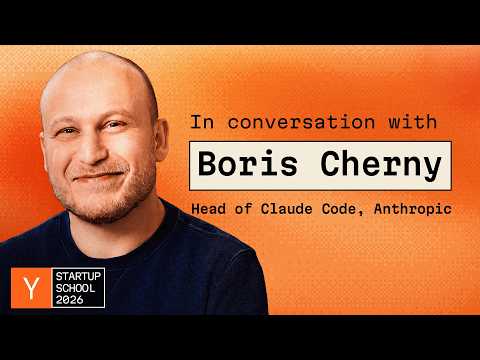
Boris Cherny: Building Claude Code

Video thumbnail: Boris Cherny: Building Claude Code
Jul 27, 202635m 52s video lengthY Combinator

The Signal

Anthropic’s Boris says the latest model, Opus 5, marks a threshold where human-engineered scaffolding often hinders rather than helps. By adopting an aggressively empirical approach—deleting system prompts and harness tools, then adding back only what demonstrably fails—the team has unlocked persistent, long-horizon autonomous tasks that previously required near-constant human oversight.

The Case

The Shift to Empirical Harnessing

  • Anthropic cut over 80% of the Claude Code system prompt for Opus 5, finding that newer models often compensate for old instructions with native capability.3:30
  • The team follows an "ablation first" workflow: they delete existing prompts and skills, test the model, and only reintroduce complexity when repeated failure makes it necessary.5:52
  • Boris frames modern AI product design as "unhobbling" the model, where the primary goal is removing product-imposed constraints to elicit latent performance.10:41

Long-Horizon Agentic Performance

  • Opus 5 enables persistent execution that the team claims can run for weeks or months, a functionality they characterize as unique among current frontier models.1:32
  • A specific Bun codebase rewrite from Zig to Rust ran autonomously for 11 days, utilizing dynamic workflows and local steering to complete the transition.16:03
  • Internal automation is now deeply integrated; the team runs 20 to 30 routines daily—such as dead code removal and test cleanup—across their own app repositories.28:13

Safety and Verification

  • Anthropic asserts it cannot demonstrate prompt injection on Opus 5 when using their three-layer defense, which combines a well-aligned base model with classifiers derived from mechanistic interpretability.2:48
  • Boris emphasizes that successful agentic work relies on task-level verification—such as pixel-by-pixel comparisons—rather than rigid, human-scripted step-by-step instructions.20:29

The 1 Minute Signal Take

This shift acknowledges that as models gain intelligence, traditional "prompt engineering" and rigid system prompts are becoming legacy debts that actively inhibit performance. The takeaway for developers is to treat the AI as an autonomous agent requiring guardrails and verification targets, rather than a deterministic script runner needing constant micromanagement.

Pro Analysis

Why It Matters

This commentary marks the transition from 'AI as a chat interface' to 'AI as a persistent workforce.' The strategic shift...
Full analysis always available on Pro.

Time saved:34m 7s

Share this

Tags

Written by: 1 Minute Signal Editorial Team