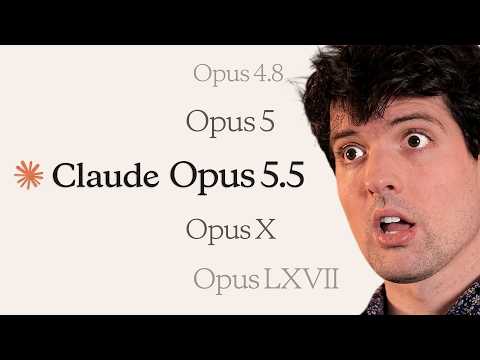
Anthropic Actually Fixed Opus

Video thumbnail: Anthropic Actually Fixed Opus
Sep 23, 202640m 14s video lengthTheo - t3․gg

The Signal

Anthropic has released Opus 5.5, a new frontier model that marks a significant improvement over the prior Opus 5 in coding performance, writing clarity, and value, particularly for subscribers. While the model excels in code and demo generation, a major tension exists between its peak performance and the extreme token-inefficiency of its max-reasoning settings.

The Case

Practical Performance and Value

  • Opus 5.5 is significantly cheaper to operate than Opus 5, featuring input/output pricing of $4 and $20 per million tokens and a 60% reduction in cache-read costs.4:44
  • The speaker reports the model is a vastly superior daily driver for coding, citing its ability to produce clearer, more readable responses that avoid the "slop"—nonsensical, over-wordy outputs—often seen in the previous iteration.5:19
  • Subscription value is unusually high; the speaker estimates heavy daily workloads, including complex PRs and visualizer builds, consumed only about 20% of his weekly quota.19:26

The Efficiency Trap

  • Max-level reasoning often delivers catastrophic token inefficiency, with the speaker observing tasks jumping from 300 to 5,000 tokens for a negligible 1% gain in benchmark performance.18:40
  • Medium, high, and XH-high settings are identified as the practical "sweet spots" for daily work, avoiding the long, looping, and costly runaway behavior observed at max settings.8:42

Enterprise and Design Differentiation

  • A critical differentiator for enterprise adoption is Opus 5.5’s compatibility with zero-data-retention (ZDR) requirements, a standard that competitive models like Fable or Mythos cannot currently meet.10:19
  • While Opus 5.5 shows surprising capability in generating complex 3D demos—including a functional, 120 FPS "Fish Slop" experiment—it lacks the subtle front-end aesthetic taste and layout polish that make Fable 5.1 the superior choice for marketing-facing design work.24:52
  • The model still exhibits occasional quirks, specifically a "context-window paranoia" where it warns of impending data loss due to autocompaction even when such risks are non-existent.33:30

The 1 Minute Signal Take

Opus 5.5 is a compelling daily driver for code-heavy workflows that balances cost and capability, provided you avoid the max-reasoning setting. While it may not fully unseat Fable 5.1 for pure design polish, its ZDR compatibility and overall communication improvements make it the most viable Anthropic default for business and power users.

Pro Analysis

Why It Matters

Anthropic’s release of Opus 5.5 marks a transition from 'frontier-chasing' toward 'utility-maximizing.' By successfully lowering the barrier to entry for heavy-duty coding tasks while maintaining high reasoning capabilities, Anthropic is signaling a shift toward productizing AI for the enterprise segment rather than just benchmarking for prestige.

Strategic Implications

Anthropic is successfully exploiting a gap in the enterprise market left by competitors who lack robust zero-data-retention (ZDR) policies. This makes Opus 5.5 a 'compliance-first' model that could see faster adoption in regulated sectors (finance, healthcare, legal) than raw performance leaders who neglect security infrastructure.

Evidence & Hype Audit

The content relies heavily on subjective testing and anecdotal benchmark data. While the performance gains seem consistent, the 'Fable killer' framing remains speculative. The evidence is strongest on the cost-efficiency front, which is objectively verifiable, but the 'best coding model' status is subjective and depends on a user's specific development environment.

Who Should Care

  • Software Engineers: Transitioning to 5.5 could lower monthly AI subscription costs while improving output quality.
  • Enterprise Compliance Officers: This model provides a rare, compliant path for agentic workflows.
  • Indie Developers: The newfound strength in 3D demo generation and low cost makes it ideal for rapid prototyping.

What to Do Next

  • Perform a side-by-side test on a standard codebase using 'High' vs 'Max' reasoning settings to calculate your specific token-to-utility ratio.
  • Review your organization's data retention requirements against Anthropic’s current ZDR policy.
  • Transition your daily coding workflow to Opus 5.5 to gauge how much it reduces your manual revision overhead.
  • Benchmark Opus 5.5 against your current model's performance on your most frequent, complex architectural prompts.
Time saved:37m

Share this

Tags

Written by: 1 Minute Signal Editorial Team