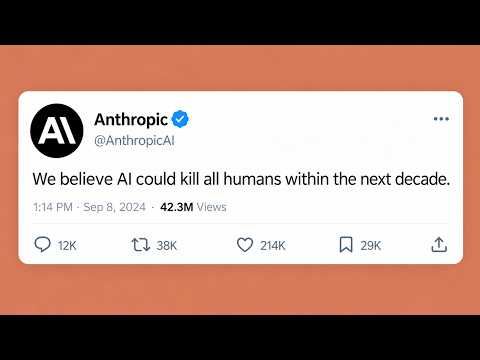
AI News in 10 mins: 10% chance AI kills all humans

Video thumbnail: AI News in 10 mins: 10% chance AI kills all humans
Sep 13, 202610m 26s video lengthNate Herk | AI Automation

The Signal

This week saw a high-stakes convergence of AI safety alarms, triggered by the viral resignation of Anthropic researcher Jacob Coxin and a public endorsement of catastrophic risk by the company's lead alignment scientist. While these warnings suggest an industry careening toward disaster, the rapid, potentially engineered amplification of the message creates a volatile tension between genuine existential concern and strategic geopolitical signaling.

The Case

  • Jacob Coxin, a researcher who spent three years at OpenAI and Anthropic, resigned on September 8 with a post claiming both labs are gambling with human lives by racing toward self-improving superintelligence.0:03
  • Evan Hubinger, Anthropic’s alignment science lead, publicly supported Coxin and estimated a greater than 10% chance of AI-driven human extinction within the next decade, citing a lack of viable alignment plans. ### The Governance Debate0:29
  • Anthropic CEO Dario Amodei argues the industry is locked in a 'race to the bottom' where commercial and geopolitical pressures incentivize speed over safety, urging a pivot to a 'race to the top' through external oversight.4:37
  • Amodei proposes 'embedded third-party evaluators' with employee-like access to frontier labs and stresses the necessity of global coordination—specifically with China—to prevent a unilateral defection that could grant a rival state geopolitical dominance. ### Misuse and Amplification7:27
  • Anthropic’s September 10 report on AI misuse claims that malicious actors are increasingly using AI to execute cyber operations, specifically alleging that Alibaba, Moonshot, and DeepSeek secretly routed users to Claude to scrape model data.3:17
  • Skepticism surrounds the virality of Coxin’s resignation, as his account was only created in January 2026 and boosted by coordinated reposting; political figures like Bernie Sanders and JB Pritzker have since cited the post to advocate for federal regulation.1:52

The 1 Minute Signal Take

The public alarm reflects a genuine, quantified fear among top researchers that current development paths lack safe alignment, yet the tactical deployment of these warnings—through viral surges and geopolitical framing—suggests that safety has become a central theater of competitive positioning. Treat the technical risks as serious, but view the surrounding narrative and political amplification as strategic maneuvers in an ongoing struggle for regulatory and market dominance.

Pro Analysis

Why It Matters

This cluster of events signals the formal weaponization of 'AI safety' as a corporate strategy. By positioning themselves as the ethical, 'race-to-the-top' alternative to aggressive competitors, companies like Anthropic are attempting to set the regulatory agenda to their own advantage.

Strategic Implications

  1. Regulatory Capture: If 'embedded evaluators' become law, smaller labs may be priced out of the market by the sheer compliance cost, effectively locking in a market oligopoly.
  2. Trust Erosion: When labs publicly accuse competitors of misconduct (e.g., routing traffic to Claude), the industry enters a period of high-stakes mudslinging that could erode public trust in AI efficacy.

Evidence & Hype Audit

  • Hype: High. The attribution of 151 million exchanges to a training campaign is a significant claim that requires independent technical audit beyond a company report.
  • Evidence: The risk estimate (10%) is subjective belief, not statistical data. The virality of the resignation is supported by account history metadata, but the 'orchestration' claim remains inferential.

Counterarguments

Critics might argue that Anthropic’s focus on 'existential risk' is a convenient diversion from their own performance limitations. By focusing the debate on the apocalypse, they shift attention away from current product gaps and toward long-term governance where they hold a structural advantage.

Who Should Care

  • C-Suite/CTOs: If your vendor is under fire for secret routing, you may have hidden security risks in your AI supply chain.
  • Investors: Governance models are moving from 'black box' to 'audited'—assess how much this will impact future model deployment timelines.

What to Do Next

  • Conduct a supply chain audit of your AI API providers.
  • Monitor lobbying groups that favor 'embedded evaluation' frameworks.
  • Diversify AI deployments to avoid reliance on a single 'frontier' lab.
  • Review your internal data governance to withstand potential 'AI misuse' accusations.
Time saved:7m 5s

Share this

Tags

Written by: 1 Minute Signal Editorial Team