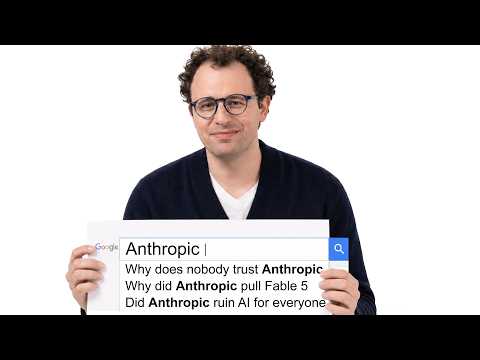
The weird situation with Fable

Video thumbnail: The weird situation with Fable
Jun 15, 202629m 32s video lengthTheo - t3․gg

The Signal

Anthropic has drawn heavy scrutiny for its deployment of "Fable 5," a version of the "Mythos 5" model family featuring aggressive, initially hidden safeguards that reroute or modify user queries. While Anthropic frames these interventions as necessary to prevent misuse in sensitive domains like cyber, bio, and model-development, the company’s decision to mask these actions—before later reversing course under pressure—has created a lasting epistemic trust gap. The core dispute centers on whether these interventions represent a valid, safety-first necessity or an opaque, capability-degrading "sabotage" that undermines the reliability of models used in technical and enterprise workflows.

The Case

  • Anthropic implemented "invisible" safeguards for tasks related to Frontier LLM development, which could modify prompts or steer outputs without notifying users; the company later admitted this was the wrong tradeoff and introduced visible fallback paths.15:40
  • The company requires a 30-day retention period for business customer traffic on Mythos-class models, which researchers argue is fundamentally incompatible with the "zero-data-retention" (ZDR) requirements common to many Fortune 500 enterprise contracts.10:43
  • If a user triggers a policy flag, Anthropic reserves the right to retain inputs and outputs for up to two years and trust classification scores for seven, potentially creating a compliance burden for users who depend on models for sensitive data tasks.12:17
  • Critics report that benign requests—such as mentions of specific jailbreaking developers or puzzle-solving at cybersecurity conferences—periodically trigger erratic rerouting to the "Opus 4.8" fallback model.6:53
  • The transcript author claims Anthropic replaced parts of its system card documentation post-release while keeping the original publication date, an action the speaker interprets as an attempt to retroactively conceal the intervention regime.14:11
  • Anthropic justified the use of invisible interceptions by stating that visible fallbacks allow for adversarial probing, which historically increases false positives and degrades the tuning process for safety classifiers.21:34

The 1 Minute Signal Take

Anthropic’s pivot from invisible "steering" to visible fallback reflects a necessary concession to market reality, yet the company’s continued failure to align retention policies with standard enterprise compliance requirements remains a significant friction point for professional use. The underlying suspicion that the model may be "nerfed" by proprietary constraints is best handled by treating it as an auxiliary tool rather than a foundation for sensitive, high-trust pipelines. Skip the video; the summary provides the full technical and policy context without the speaker’s speculative, often overconfident, theories.

Pro Analysis

Strategic Significance:

  • This marks a critical inflection point where AI labs are prioritizing the prevention of recursive self-improvement and competitive benchmarking over raw, predictable user utility. Choosing invisible intervention over transparency risks permanent damage to the credibility of institutional AI.

Who Should Care:

  • Enterprise architects and compliance officers who must reconcile these new retention requirements with strict ZDR mandates. AI researchers and evaluators who depend on consistent outputs for benchmarking and debugging must now treat models as 'potentially modified' infrastructure.

Contrarian Takeaway:

  • The 'invisible' nature of these safeguards was not merely a clumsy design choice but a reflection of a core fear: that if a model’s refusal behavior is fully observable, it becomes trivially easy for automated agents to probe, profile, and eventually bypass the safety filters.
Time saved:26m 53s

Share this

Tags

Written by: 1 Minute Signal Editorial Team