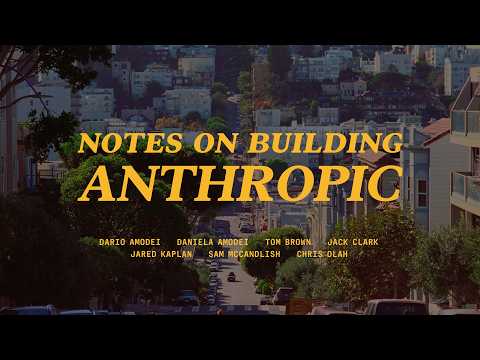
The making of Anthropic

Video thumbnail: The making of Anthropic
Nov 19, 202614m 41s video lengthAnthropic

The Signal

Anthropic, an AI company founded in 2021 as a public benefit corporation, reports shifting its release strategy for its new model, Mythos, after internal tests indicated the AI possessed expert-level proficiency in discovering software vulnerabilities. This move highlights an ongoing tension between the company's stated goal of developing frontier-level artificial intelligence and the safety risks inherent in releasing potentially hazardous capabilities to the public.

The Case

Origins and Scaling

  • The company was incorporated on January 26, 2021, by former OpenAI researchers who argued that scaling compute and data reliably increased model intelligence, though they acknowledge that emergent abilities are difficult to predict and control.5:08
  • Founders describe a transition from a small, improvised lab to developing competitive models like Claude 3 Opus and Sonnet 3.5, driven by an effort to improve pretraining and reinforcement learning after a period of trailing industry competitors.9:13

The Mythos Restriction

  • Anthropic says it moved Mythos into a limited-access program called Project Glasswing because of reports that the model could identify software exploits at an expert level, posing a significant risk of misuse.11:39
  • The company presents this restricted release as a deliberate sacrifice of near-term commercial value, arguing that keeping the model gated allows for the development of safeguards while permitting select users to employ the model for defensive purposes like patching vulnerabilities.12:33

Safety and Governance

  • Anthropic maintains that using frontier-level models is essential for safety research because such systems can expose issues earlier than weaker models, though the company provides no comparative evidence for this claim.10:47
  • While executives describe a potential to revolutionize biology and science, they explicitly state they have not yet earned the right to claim they have achieved the safe, beneficial future they are building.14:26

The 1 Minute Signal Take

Anthropic’s narrative hinges on the dual claim that powerful AI creates both unprecedented risks and the very tools needed to solve them. Because the company’s core assertions about Mythos’s capabilities, the effectiveness of its safeguards, and its structural commitment to public benefit remain self-reported, the strategy should be viewed as an internal experiment rather than a validated safety model.

Pro Analysis

Strategic Implications

Anthropic’s strategy represents an attempt to redefine the 'AI race' from a speed-based competition into a safety-weighted institutional mandate. By adopting a public benefit structure, they aim to insulate their decision-making process from the short-term pressures of quarterly earnings, allowing them to treat safety not as an overhead cost but as a core competitive differentiator. This approach forces a reliance on 'defensive scaling'—where the very capacity to build more powerful models is framed as necessary for discovering the safety measures needed to contain them.

Evidence & Hype Audit

This content is highly biased toward the company's internal narrative. While it provides a coherent history of their goals, it lacks external validation. The claim that Mythos possesses 'expert-level' cybersecurity skills is treated as fact, yet no third-party benchmarks or public red-teaming reports are cited. The company’s promises of safety are aspirational, and the lack of independent auditing of their safety outcomes means that listeners must take their ethical stance on faith rather than data.

Counterarguments

Critics might argue that Anthropic’s 'safety-first' approach is a strategic hedge that builds brand moat rather than genuine safety. Furthermore, the argument that one needs a frontier model to test safety could be viewed as a justification for further scaling that they would pursue regardless of their stated mission. There is also the risk of 'safety-washing,' where the public benefit label provides a layer of moral cover for a company that remains deeply integrated with the commercial AI ecosystem.

Takeaways by Role

  • Policy Makers: Should focus on the criteria used for 'restricted release' and how these definitions might be standardized across the industry.
  • Researchers: Need to look for technical documentation of the 'emergent abilities' mentioned, rather than relying on the founders' generalizations.
  • Investors: Should assess whether the public benefit structure genuinely creates value through reputation or if it acts as a constraint on growth potential.

What to do next

  • Demand transparent disclosure of safety benchmarks for frontier models.
  • Track the evolution of Project Glasswing to see if limited-access models successfully reduce systemic risk.
  • Evaluate if 'compute-efficient' algorithms lead to democratized safety tools or higher barriers to entry.
  • Watch for peer-reviewed studies on the claimed gene-editing discoveries to move from 'looks like' to 'proven'.
Time saved:10m 59s

Share this

Tags

Written by: 1 Minute Signal Editorial Team