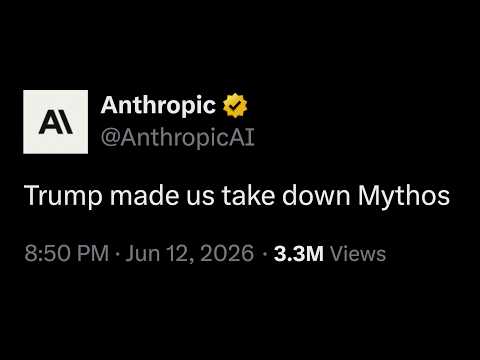
BREAKING: Fable and Mythos have been taken down for security concerns.

Video thumbnail: BREAKING: Fable and Mythos have been taken down for security concerns.
Jun 13, 202614m 20s video lengthTheo - t3․gg

The Signal

Anthropic has received a US government export-control directive requiring the immediate suspension of Fable 5 and Mythos 5 access for all foreign nationals, including its own employees. The company claims the order stems from a narrow jailbreak demonstration—but argues the action is disproportionate because this vulnerability is already discoverable by other mainstream models like GPT-5.5. The central tension pits the government's precautionary national-security mandate against Anthropic’s contention that the directive is technically unjustified and threatens to halt frontier AI innovation.

The Case

  • Anthropic received a national-security directive at 5:21 p.m. ET, demanding it block access to Fable 5 and Mythos 5 for every foreign national, regardless of their location, forcing the company to abruptly disable both models globally to remain in compliance.3:46
  • The company asserts the government’s move was triggered by a specific bypass demo that revealed only a small number of previously known, minor vulnerabilities.
  • Anthropic defends its safety record by citing thousands of hours of red-teaming—including collaboration with the UK AISI—and claims that no universal jailbreak has ever been discovered for Fable 5.5:04
  • By comparing the finding to the capabilities of competitors like OpenAI’s GPT-5.5, Anthropic argues that the vulnerability is not uniquely dangerous and that its existing defense-in-depth strategy is standard for the industry.7:52
  • The speaker speculates the timing may be retaliatory, noting the directive arrived just two days after Anthropic publicly urged the federal government to set clear standards rather than blocking state-level AI legislation.13:11
  • While access remained functional at the time of recording, community-led monitoring tools are now probing the service every five minutes to track the expected, imminent blackout.

The 1 Minute Signal Take

The conflict here hinges on a technical asymmetry: Anthropic claims the vulnerability is routine and manageable, while the government remains silent on its specific evidentiary threshold. Given the lack of a disclosed rationale or technical proof justifying this specific recall, the company’s argument that this sets a dangerous, overbroad precedent for the industry is currently the most credible take. Watch the video if you want the speaker's emotional framing of the potential industry fallout, but you can safely skip it if you only need the hard facts.

Pro Analysis

Strategic Significance

This event marks a shift from passive oversight to active enforcement in the frontier AI space. The directive treats powerful LLMs not merely as software, but as strategic assets akin to cryptographic systems or dual-use technologies, subject to national-security export controls. It signals that regulators are now willing to prioritize containment over commercial continuity when a potential jailbreak is identified, regardless of how "minor" the underlying vulnerability may be.

Who Should Care

  • Enterprise AI Architects: Those integrating frontier models into critical infrastructure must now account for the risk of sudden, compliance-triggered API blackouts.
  • Policy Makers: The situation provides a real-world case study for the debate between rigid state-backed controls and industry-led safety mechanisms.
  • Foreign-National AI Researchers: This sets a chilling precedent that work access may be limited by nationality, regardless of employment or institutional affiliation.

Contrarian Takeaway

While the industry views this intervention as a threat, the government may be intentionally targeting a specific, non-public capability that makes the model a uniquely useful tool for automated exploit generation, even if those specific exploits appear 'minor' in isolation.

Time saved:11m 33s

Share this

Tags

Written by: 1 Minute Signal Editorial Team