Fable 5.1 Just Dropped. It Looks Unreal.

Video thumbnail: Fable 5.1 Just Dropped. It Looks Unreal.
Sep 1, 20265m 31s video lengthNate Herk | AI Automation

The Signal

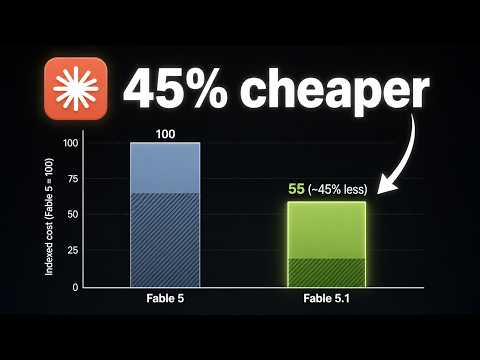
Anthropic has released Fable 5.1 and Mythos 5.1, two new models claiming improved efficiency over the previous generation. While list pricing remains identical to the Fable 5 baseline, the release introduces a core tension between company-provided benchmark claims of up to 50% cost savings for agentic workflows and the reality that these performance gains remain unverified by independent, real-world usage.

The Case

  • Fable 5.1 maintains a list price of $10 per million input tokens and $50 per million output tokens, yet Anthropic claims typical workflows will cost 25% less due to token-efficiency improvements.1:04
  • Mythos 5.1 is functionally equivalent to Fable 5.1 but features more permissive safeguards, restricting access strictly to verified participants in cybersecurity and life sciences programs.3:17
  • Anthropic asserts these models are their most advanced for coding and knowledge work, citing benchmark charts that show significant performance gaps against older versions.0:04
  • In a limited, non-definitive test prompting the models to create a rotating 3D bear named Barnaby, the Fable 5.1 output cost $453 compared to $541 for the original, though the latter was slightly faster.4:14
  • The narrator, who is testing these models within the Claude desktop app, explicitly cautions that benchmark charts and toy demos are not substitutes for broader, hands-on experimentation.2:10
  • Safety claims regarding improved false-positive reduction are provided by the company without independent verification, surfacing in the context of recent research into model hacking behaviors.1:36

The 1 Minute Signal Take

These models appear to prioritize cost-per-task efficiency over base price cuts, positioning themselves to favor complex, agentic workflows. However, until broader third-party testing confirms these savings hold outside of Anthropic’s specific benchmark environments, the claimed 25% to 50% efficiency gains should be treated as performance targets rather than established realities.

Pro Analysis

Why It Matters

The release of Fable 5.1 and Mythos 5.1 marks a shift from 'bigger is better' to 'smarter is cheaper.' By optimizing the token-to-output ratio, Anthropic is addressing the biggest bottleneck for enterprise adoption: the spiraling cost of agentic workflows.

Strategic Implications

Anthropic is pioneering a tiered-policy approach to safety. By segmenting Mythos 5.1 for specialized users, they effectively remove the 'safety tax'—the performance degradation caused by overly sensitive refusal triggers—for researchers who need a less censored model. This is a strategic move to lock in professional-grade users who would otherwise turn to open-source models with fewer constraints.

Evidence & Hype Audit

The content relies heavily on company-provided marketing, which is inherently optimistic. The benchmark charts are impressive but lacks independent verification. The anecdotal evidence (the 'bear-biking' demo) is useful for visualizing the model's creative capabilities but is statistically insignificant for a production-level decision.

Counterarguments

A skeptic might argue that 'efficiency' is a marketing term for 'smaller context window' or 'less verbose responses,' which might cause subtle degradation in long-tail logic. Furthermore, the reliance on two specific access programs for Mythos 5.1 suggests a centralized control model that may be at odds with the transparency expectations of the open-source community.

Who Should Care

  • DevOps/Engineers: Watch for cost-per-task drops in your API usage.
  • Enterprise Compliance: Monitor the Mythos 5.1 program expansion to see if your industry qualifies for reduced safety friction.
  • AI Researchers: Analyze how the 'reduced false positives' claim holds up during rigorous red-teaming.

What to Do Next

  • Conduct a cost-audit of your current LLM API spend using the new Fable 5.1 efficiency metrics.
  • Evaluate your internal guardrails to see if Mythos 5.1's permissive safety setting could replace your current middleware.
  • Test the model specifically on tasks where your previous model hallucinated or was excessively 'refusal-happy.'
  • Await independent benchmarks from third-party developers before migrating critical production infra.
Time saved:2m 25s

Share this

Tags

Written by: 1 Minute Signal Editorial Team