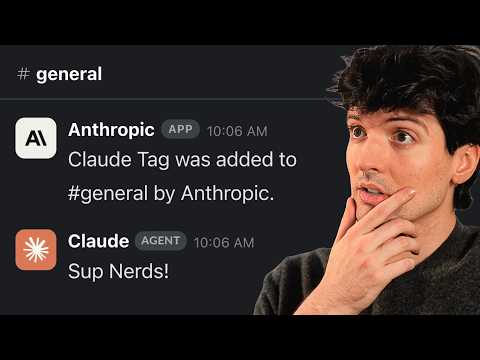
The next paradigm shift (according to Karpathy)

Video thumbnail: The next paradigm shift (according to Karpathy)
Jun 25, 202620m 47s video lengthTheo - t3․gg

The Signal

Anthropic’s new Claude Tag integration for Slack is not just a bot, but a channel-scoped, persistent org agent that shares context across team members. While Anthropic claims its product team generates 65% of its code via this tool, debate persists over whether Slack is the optimal long-term abstraction for team agents and whether Claude Tag’s inability to switch models limits its utility for power users.

The Case

  • Claude Tag acts as a persistent channel participant that builds memory and provides tool access over time, allowing multiple humans to collaborate with one agent in a shared thread.0:02
  • Anthropic claims massive internal adoption, stating that 65% of its product team’s code is written using an internal version of this tool.5:36
  • The author’s own experience with custom agents like 'Hermes' proves that single-thread systems fail when concurrent tasks—like scheduled 11:00 a.m. jobs—collide, justifying the need for task isolation.11:58
  • Channel-level boundaries serve as a superior proxy for team organization, reducing the 'context pollution' seen in global or project-specific agent setups.8:52
  • The author’s primary criticism is vendor lock-in; they argue that the system is incomplete because it prevents users from switching models to leverage the strengths of different AI providers.16:41
  • The feature is gated behind Anthropic’s Team and Enterprise plans, restricting it to organizations that fit the company’s specific licensing model.1:44
  • Promotion of 'Code Rabbit' as a sponsor highlights a separate but related critique of code review tools, where the author asserts that structured diffing has helped prevent production outages.

The 1 Minute Signal Take

The video offers a coherent technical defense of channel-based agent architectures, grounding its analysis in the author's real-world agent orchestration failures. Watch it for the tactical setup advice and the honest critique of vendor lock-in, but skip the sponsor segment and the speculative framing about 'paradigms.'

Pro Analysis

Strategic Significance:

  • This design marks a transition from 'AI as a Tool' to 'AI as a Team Member.' By moving away from ephemeral threads, organizations can treat model interaction as a durable part of their operational history.

Who Should Care:

  • Team Leads and Engineering Managers: Because this pattern significantly reduces the overhead of briefing agents on ongoing project state.
  • Power Users: Because the shift toward channel-level orchestration validates the need for agent isolation and persistent memory.

Contrarian Takeaway:

  • The most effective agent interfaces will likely be those that minimize the time a user spends in a dedicated 'AI application,' instead embedding intelligence into the coordination platforms where the team already lives.
Time saved:18m 39s

Share this

Tags

Written by: 1 Minute Signal Editorial Team