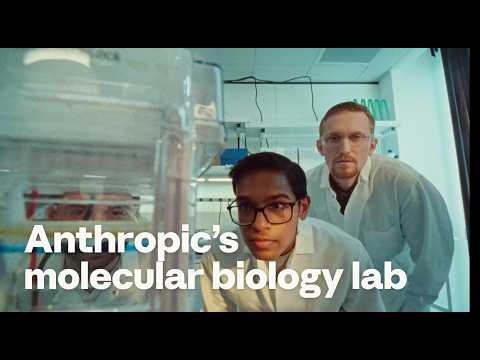
Inside Anthropic's molecular biology lab

Video thumbnail: Inside Anthropic's molecular biology lab
Sep 23, 20261m 16s video lengthAnthropic

The Signal

Biology remains a vast, largely uncharted frontier, with the speaker estimating that we do not understand the function of half of all proteins. This structural uncertainty, the speaker argues, makes discovery both inevitable and unpredictable. The central tension lies in integrating AI as an active scientific collaborator to accelerate this discovery process despite the inherent volatility of experimental research.

The Case

Current Knowledge Gaps

  • The speaker characterizes biology as fundamentally underexplored, claiming that science does not yet understand how roughly half of all proteins—which perform the majority of molecular functions—actually work.0:13
  • This state of ignorance is presented as the primary driver for a scientific outlook that favors an "unlimited" potential for new discovery.

Managing Uncertainty

  • The speaker asserts that biological systems routinely disrupt research plans; they warn that while scientists may hope experiments proceed exactly as designed, it is nearly inevitable that reality will force researchers to change course.
  • As a working heuristic, the speaker advises researchers to maintain comfort with not knowing and to strictly withhold belief in any hypothesis until results are directly observed.

AI as Collaboration

  • Claude—an AI system developed by Anthropic—is positioned as a core collaborator in the scientific workflow rather than just a tool, with the speaker claiming it will enable far more discoveries than were previously possible.0:45
  • While the speaker presents this collaborative model as a gateway to paradigm-shifting insights, the assertion that AI will materially increase discovery output is a future-oriented projection rather than an evidenced result.

The 1 Minute Signal Take

The speaker’s narrative highlights a strategic shift toward using AI to brute-force biological unknowns, yet the actual efficacy of this approach remains speculative. Readers should view the claims about AI-driven discovery acceleration as aspirational marketing rather than verified fact.

Pro Analysis

Why It Matters

Biology is a data-rich, understanding-poor environment. If AI can genuinely move the needle on protein function discovery, it represents a transition from descriptive biology to predictive engineering, potentially shortening development cycles for medicine and synthetic materials.

Strategic Implications

For research organizations, this signals a shift toward 'AI-native' workflows where the model's contribution is embedded in the experimental loop. It suggests that institutional agility—being able to pivot based on AI-suggested hypotheses—may soon be a competitive advantage.

Evidence & Hype Audit

The content leans heavily into aspirational marketing. While the claim regarding unknown protein function aligns with general scientific consensus, the efficacy of Claude as a 'collaborator' is presented as an assertion without concrete validation data. Readers should view the claims of 'far more discoveries' as a hypothesis of the lab, not a proven metric.

Counterarguments

A traditional skeptic might argue that AI, by its nature, can hallucinate or reinforce biases inherent in existing protein datasets. Over-reliance on an AI collaborator could lead to 'path dependency,' where the scientific community explores only the hypotheses suggested by the model, potentially missing novel outliers that contradict AI training data.

Role-Specific Takeaways

  • Lab Leads: Focus on integrating tools that force researchers to stay flexible in the face of negative results.
  • AI Developers: Develop systems that focus on uncovering novelty, not just summarizing existing literature.
  • Investors: Look for evidence of specific, reproducible findings rather than general claims of increased productivity.

What to Do Next

  • Audit current research workflows to identify where 'fixed' planning is blocking discovery.
  • Implement a 'truth-first' policy for AI-generated hypotheses requiring mandatory validation.
  • Evaluate the 'half of proteins' gap as a target for specific R&D initiatives.
  • Establish a baseline for current discovery throughput to measure actual AI impact.

Share this

Tags

Written by: 1 Minute Signal Editorial Team