
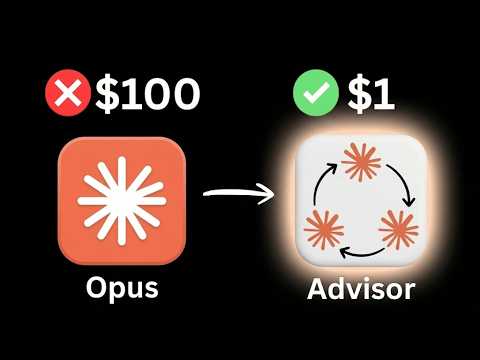
- The advisor strategy prevents wasting budget by using high-end models for simple tasks.
- Sonnet or Haiku serve as the execution layer, while Opus acts as the intelligent advisor.
- Implementing this architecture led to a 2.7% performance increase on industry benchmarks like SWE-bench.
- The Messages API allows for defining maximum usage limits for the advisor to control costs.
- Output tokens are significantly more expensive than input tokens across all models, making model selection critical.
- Tools define the capabilities an agent has; both the API and Claude Code utilize these effectively.
- The 'Opus Plan' feature in Claude Code automates switching to Opus for complex reasoning tasks.
- Consistent testing is required to determine the ideal balance of performance and cost for production apps.
Claude Just Told Us to Stop Using Their Best Model
Nate Herk | AI Automation
The video demonstrates how to optimize AI agent performance and costs by using the Anthropic Advisor strategy, which pairs smaller models as executors with a larger model acting as an advisor.
Key Takeaways
- The advisor strategy allows developers to use smaller, faster models like Haiku or Sonnet for routine tasks while offloading complex reasoning to a more capable model like Opus.
- Implementing this tiered intelligence approach provides near-Opus performance at a fraction of the cost, reducing expenses per agentic task significantly.
- Developers can use the 'Opus Plan' mode in Claude Code to strategically employ advanced reasoning only when strictly necessary, preserving session usage limits.
Talking Points
Pro Analysis
Strategic Importance
This strategy addresses the primary bottleneck in scaling AI production: the cost-performance trade-off. By decoupling the 'reasoning engine' from the 'execution engine,' companies can drastically lower their operational overhead while maintaining high execution standards.
Who Should Care
- Software Engineers: Moving beyond brute-forcing prompts with the most powerful model, and building efficient agentic pipelines.
- Product Managers: Need to understand infrastructure costs when integrating AI features that rely on high-frequency API calls.
Non-Obvious Takeaway
Complexity is not the only metric for advisor usage. As demonstrated in the test runs, sometimes the cheaper, more agile model (Haiku) provides more practical and concise communication for customer-facing tasks than the 'smarter' Opus, which may over-engineer its responses. Efficient AI deployment is about matching the model's 'personality' and capability to the user's specific context, not just its raw IQ.
Time saved:
Written by: 1 Minute Signal Editorial Team