
- Defining clear goals is the foundational step for any Auto Research experiment.
- The system excels at hyperparameter tuning, prompt engineering, and code refactoring.
- Humans must remain 'in-the-loop' to manage the potential for automated errors or financial risks.
- Using Auto Research as a 'service' can create high-margin retainer models for agencies.
- AgentHub introduces a 'GitHub for agents' model for collaborative, swarm-based coding.
- Nvidia GPUs are currently essential for high-performance training loops.
- The technology transforms research tasks—like competitor analysis—from manual toil into automated living dashboards.
- Integrating an 'optimize button' into software provides a competitive advantage for existing SaaS platforms.
- Financial modeling and risk assessment can be improved through overnight back-testing of trading strategies.
- The tool is effectively a force multiplier for individual contributors aiming to out-perform larger teams.
Karpathy's "autoresearch" broke the internet
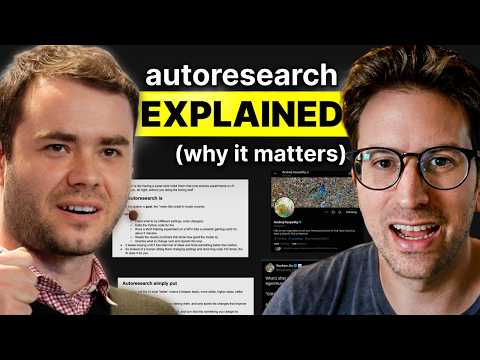
Greg Isenberg
Key Takeaways
- Auto Research acts as an automated research assistant that iteratively runs experiments, tests configurations, and saves performance improvements based on your specific goals.
- The tool requires a defined objective, access to computational resources, and iterative cycles where the agent acts, reads results, updates its internal logic, and retains winning configurations.
- Practical applications range from optimizing software and SaaS pricing to automating marketing A/B testing, clinical trial protocols, and complex data-driven business operations.
- Deployment typically requires an Nvidia GPU directly or via cloud services like RunPod or Google Colab, making the technology accessible to developers and non-technical founders alike.
Talking Points
Pro Analysis
Strategic Analysis
This technology marks a paradigm shift from 'coding as creation' to 'coding as optimization.' It is strategically vital because it collapses the feedback loop of experimentation, enabling individuals to run thousands of tests that would previously have required large R&D teams.
For leaders, this means current organizational hierarchies defined by manual knowledge work will become obsolete. The primary value shifts from knowing the answer to knowing how to prompt the search for it. It forces a transition toward 'managing swarms' of agents rather than supervising juniors.
The Contrarian Takeaway
The most critical danger is 'optimization blindness.' While Karpathy’s tool is powerful, it is designed for local maxima optimization. It will aggressively improve performance metrics (like CTR or model accuracy) but may miss systemic risks or ethical considerations that are not explicitly defined in the objective function. Leaders should expect a rise in 'metric-perfect, strategy-empty' outcomes if agency oversight is neglected.
Next Steps:
- Define one objective in your current workflow where performance is measured numerically (e.g., email open rates).
- Prototype a simple recursive script to iterate on that task.
- Audit the results for quality, not just the target metric, to build human-in-the-loop safeguards.
Time saved:
Written by: 1 Minute Signal Editorial Team