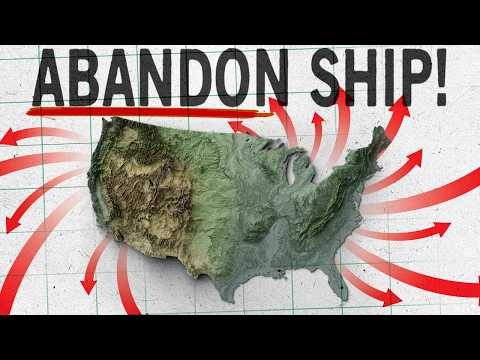
Is America Chasing Away All Of Its Smart People?

Video thumbnail: Is America Chasing Away All Of Its Smart People?
Aug 9, 202621m 21s video lengthHow Money Works

The Signal

The United States is experiencing a measurable exodus of scientific and technical talent, with researchers, federal experts, and senior academics increasingly moving abroad or into private industry. While the U.S. historically leveraged top-tier funding and institutions to attract global brainpower, a combination of selective budget cuts, affordability crises, and aggressive foreign recruitment has placed the American scientific training pipeline at risk of long-term erosion.

The Case

The Scope of the Outflow

  • 80% of U.S.-based postdoctoral researchers report they are actively seeking positions abroad, while a Nature poll suggests 75% of researchers are considering leaving the country entirely.0:00
  • Federal scientific capacity is shrinking at an unprecedented rate, with more than 15,000 doctorate-level experts departing federal agencies in 2025 alone.0:22
  • Applications from American scientists to Canada have risen by 41%, while the number of U.S.-based researchers applying to prestigious European Research Council grants increased from 23 to 114 in a single cycle.

Strategic Competition

  • Other nations are actively headhunting U.S.-trained talent; Canada launched a $1.7 billion recruitment program targeting 1,000 world-leading researchers, while the EU introduced a €500 million package aimed at attracting international science talent.6:31
  • China has overtaken the U.S. in R&D resources when adjusted for purchasing power parity, and its recruitment efforts for nationals trained in the West now include signing bonuses reaching $700,000.7:24
  • More than 80 current and former professors from institutions like Stanford and UC Berkeley have left for private AI labs such as OpenAI and Anthropic, raising concerns that industry is siphoning off the mentors needed to train the next generation of scientists.15:16

The Fundamental Dispute

  • Skeptics argue this outflow is a natural, perhaps even beneficial, reallocation of talent, noting that international students contributed $43 billion to the U.S. economy last year.20:12
  • Proponents of the "brain drain" theory contend that the U.S. is losing its foundational research base, pointing to historic data showing that the migration of scientists in the 1930s boosted U.S. patenting by one-third, suggesting that losing this talent is a direct threat to future military and economic dominance.8:43

The 1 Minute Signal Take

The U.S. scientific advantage is no longer guaranteed by inertia or prestige alone. Whether this shift represents a manageable correction or a structural decline depends on whether the country can retain its research pipeline in an era where foreign states are intentionally subsidizing the exodus of American-trained expertise.

Pro Analysis

Why It Matters

The transition of the US scientific ecosystem from a 'pull' model to a 'push' model represents a fundamental shift in national power. If the US loses its role as the global incubator for breakthrough science, it risks losing the foundational technologies that sustain its economic and military hegemony.

Strategic Implications

The shift of top academics into private AI labs creates a 'winner-takes-all' market for intelligence. While this may accelerate short-term product innovation, it starves the broader academic ecosystem of the mentorship necessary to sustain long-term progress. Furthermore, international governments have realized that the US's greatest vulnerability is its domestic political and fiscal instability.

Evidence & Hype Audit

This content is highly indicative of a shifting landscape but relies on specific, often alarming, data points to frame a broader narrative. It treats correlation (e.g., funding cuts leading to departures) as causation. The usage of the $635,000 postdoc salary figure is a significant red flag that suggests the narrator may have conflated data or relied on an incorrect source, undermining the purely quantitative credibility of the segment.

Counterarguments

Critics might argue that the 'brain drain' is a natural rebalancing in a globalized economy. They would note that talent is still moving toward where it is most valued, and that the concentration of talent in industry labs is simply an evolution of how private capital manages R&D, potentially leading to faster commercialization of research.

Who Should Care

  • Policymakers: Must evaluate if current research budget allocations are trading long-term security for short-term austerity.
  • University Administrators: Need to find ways to keep top talent within academia, perhaps through better public-private hybrid models.
  • Researchers: Should treat this as a signal to diversify their options and seek stable, multi-national funding sources.

What To Do Next

  • Audit personal career mobility against international research funding trends.
  • Advocate for the preservation of non-commercial basic science budgets.
  • Monitor faculty retention rates at your local research institutions.
  • Evaluate the long-term impact of AI-lab recruitment on your field’s teaching capacity.
  • Engage with public policy forums regarding scientific infrastructure investment.
Time saved:17m 33s

Share this

Tags

Written by: 1 Minute Signal Editorial Team