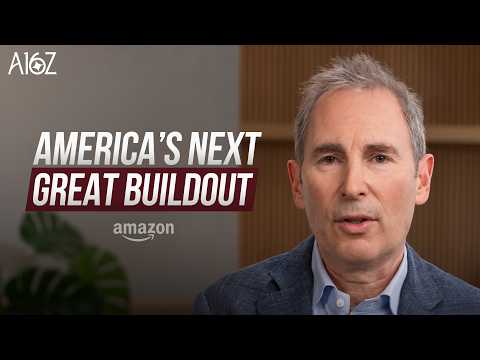
Amazon CEO Andy Jassy on the $220 Billion AI Buildout

Video thumbnail: Amazon CEO Andy Jassy on the $220 Billion AI Buildout
Oct 23, 20261h 39s video lengtha16z

The Signal

Amazon’s AI demand is so intense that the company is effectively sold out of infrastructure capacity through 2027, with significant portions of 2028 already booked. CEO Andy Jassy frames this as a historic, multi-wave transformation—AI, robotics, and space—while managing the tension between massive $220B capital expenditures and a commitment to not gouge existing cloud customers during the shortage.

The Case

Infrastructure and Scarcity

  • Amazon is investing $220 billion in 2026 capex, yet it still faces unmet demand; infrastructure is sold out through 2027 and partially into 2028.0:00
  • To manage this shortfall, Jassy says AWS will not monetize scarcity by squeezing existing cloud customers; they prioritize long-term trust over harvesting short-term price premiums from AI labs.25:59
  • Data-center buildout is front-loaded, with shells requiring 2 years of lead time before servers—which break even in 3 years—are installed.14:27

Chips and AI Adoption

  • Jassy argues inference costs remain an order of magnitude too expensive for pervasive enterprise adoption, necessitating Amazon’s reliance on custom chips like Trainium, which is 30–40% more price performant than competitors.32:49
  • Graviton, Amazon’s custom CPU, is used by 99% of top EC2 customers and offers 40% better price-performance than standard x86 processors.31:20
  • AWS AI revenue reached a $25 billion run rate in its first three years, a speed Jassy describes as materially faster than the initial AWS cloud trajectory.13:05

Organizational Redesign

  • Internal efficiency metrics show AI allows for radical restructuring; a Bedrock inference engine rebuild took six engineers 76 days, a task previously estimated at 40 people for a full year.37:21
  • Jassy warns that the most immediate AI risk is cybersecurity, as models can identify vulnerabilities faster than humans can patch them, necessitating software architectures that allow for agentic, minute-by-minute updates.43:04
  • The company expects major consumer products—including Alexa—to be rewritten from scratch to be AI-native rather than just incrementally improved.49:06

The 1 Minute Signal Take

Amazon is treating current infrastructure bottlenecks as a temporary capital intensity required to secure long-term leadership in a market moving faster than its own cloud expansion. Readers should note the shift in emphasis from simple cloud optimization to a fundamental rewrite of both internal org structures and external software security, driven by the belief that incremental AI adoption will be uncompetitive within five years.

Pro Analysis

Why It Matters

This update provides a rare, transparent view into the capital-intensive reality of the AI transition. It demonstrates that the 'AI revolution' is bottlenecked by physical infrastructure—power and data centers—rather than just software innovation. Jassy’s narrative underscores that we are currently in the 'heavy lifting' phase of the tech cycle, where winners are determined by infrastructure scale and chip-level economics.

Strategic Implications

Amazon is effectively hedging its risk. By splitting its capex between long-life data center assets (30-year life) and shorter-life server gear (3-year cycle), they can throttle their spending based on real-time demand signals. This creates an 'option value' strategy that competitors relying entirely on external cloud providers may lack.

Evidence & Hype Audit

  • Strong Evidence: The internal metrics for fulfillment re-architecture and the Bedrock team efficiency are concrete, verifiable examples of operational success.
  • Hype Caution: The claims about AI becoming 'pervasive' in 5-7 years are speculative forecasts. Additionally, Jassy’s defense of data-center environmental impact is clearly curated, using selective comparisons (golf courses/almonds) to deflect broader grid-capacity criticism.

Contrarian View

While Jassy argues that Amazon isn't squeezing customers, a market skeptic might note that the 'sold-out' capacity creates a de facto barrier to entry for smaller startups that cannot sign multi-year, multi-gigawatt commitments. The resulting 'platform lock-in' could stifle the next wave of AI-native innovation.

Role-Specific Takeaways

  • CTOs/Engineering Leads: Audit your codebase now for 'agentic compatibility.' If your security patching cycle isn't measured in minutes, you are already behind.
  • Finance Leaders: Recognize that AI-driven capital intensity is not a temporary spike; it is a structural change to the P&L requiring multi-year planning horizons.

Next Steps

  • Re-evaluate current cloud spend for 'AI-inference efficiency' rather than just general compute.
  • Begin testing 'agentic' code-update pipelines in non-critical environments.
  • Map your organization’s talent and structure against the 'smaller, agent-heavy team' model.
  • Review your infrastructure agreements to assess capacity-exhaustion risk for 2027 and 2028.
Time saved:57m 5s

Share this

Tags

Written by: 1 Minute Signal Editorial Team