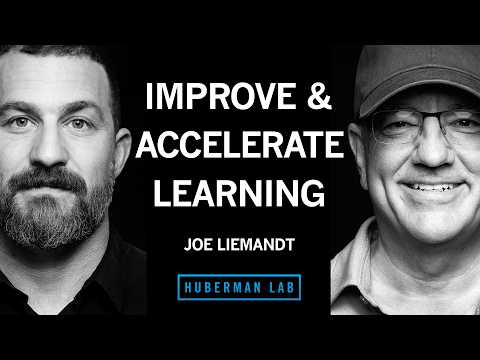
How to Accelerate Learning & Improve Education | Joe Liemandt

Video thumbnail: How to Accelerate Learning & Improve Education | Joe Liemandt
Aug 31, 20262h 33m 43s video lengthAndrew Huberman

The Signal

Alpha School argues that traditional education’s age-based pacing causes compounding failure by ignoring foundational gaps. By using AI for individualized mastery-based learning alongside human guides for motivation, the school claims it can achieve faster learning in two hours a day than traditional schooling does in six, fundamentally aiming to produce builders rather than consumers.

The Case

  • The school claims that many student failures stem from missing prerequisite knowledge rather than an inability to learn; fixing basic fluency—like multiplication tables—can lead to immediate leaps in complex academic performance.0:00
  • Alpha employs AI to generate lessons tailored to a child’s specific level, allowing students to learn at their own pace and close gaps privately; this is explicitly distinguished from using AI chatbots for cheating or generic academic assistance.31:07
  • Motivation is treated as the primary lever for student growth. The school uses structured incentives like cash prizes for reaching the top 1% or hitting grade-level milestones to break identity blocks where students believe they are simply 'not that kind of person.'12:43
  • Afternoon programming focuses on 'builder' competencies, including entrepreneurship, financial literacy, and community contributions; students run businesses, organize festivals, and manage projects to transition from passive consumers to creators.1:13
  • The school contends that human guides remain essential to the model. While AI handles routine academic assessment, guides are tasked with mentoring, confidence-building, and socialization, specifically helping children navigate the emotional difficulty of struggle and failure.
  • Alpha claims its model is not exclusive to wealthy families. It is scaling through voucher-funded programs and public-school pilots, with plans to build lower-cost schools internationally that target diverse socioeconomic settings.2:26

Scaling and Validity

  • The school’s internal data, including a 1530 average SAT score and rapid learning gains, is presented as evidence of its efficacy, though these results are currently self-reported and have not been independently audited.1:36
  • Alpha has partnered with MIT’s Blueprint Labs to run randomized controlled trials, aiming to move beyond internal anecdotal evidence and selection-effect critiques to validate its impact at scale.144:03

The 1 Minute Signal Take

Alpha’s model hinges on the premise that motivation and prerequisite mastery are the two most neglected variables in modern education. Whether its impressive reported gains are truly portable to public systems, or merely the result of a high-agency niche environment, remains the central unanswered question.

Pro Analysis

Why It Matters

Alpha School represents a high-stakes bet on the 'unbundling' of education. By moving academic content delivery to AI and keeping human interaction for high-value mentorship, it attempts to solve the 'Bloom’s 2-Sigma Problem'—the realization that individual tutoring consistently outperforms traditional classroom instruction by two standard deviations.

Strategic Implications

If successful at scale, this model threatens the institutional foundations of K–12 education. It suggests that the 'factory model' of education is not a necessity for socialization but a relic of an era lacking adaptive technology. Institutions that fail to integrate personalized mastery will likely see their value proposition collapse.

Evidence & Hype Audit

  • Trustworthiness: The claims are highly coherent and grounded in established cognitive science (e.g., scaffolding, mastery learning, fluency). However, the evidence is almost entirely internal.
  • Hype: There is a strong streak of Silicon Valley optimism, particularly regarding the ease of scaling these results to 'a billion kids' and the effectiveness of financial incentives. Independent, third-party RCTs (like the planned MIT Blueprint Labs study) are essential for validation.

Counterarguments

Critics argue that Alpha may suffer from extreme selection bias, where success is driven by high-agency families and motivated students rather than the pedagogy itself. There is also a concern that removing the common, albeit imperfect, experience of standardized schooling could erode the social cohesion that public education aims to provide.

Who Should Care

  • Policymakers: To reconsider voucher and curriculum mandates.
  • Parents: Seeking to understand if they can replicate mastery-based home learning.
  • Ed-Tech Founders: Observing a blueprint for how AI and human guidance should be blended.

What to Do Next

  • Audit a child's current learning for prerequisite gaps rather than grade-level progress.
  • Explore mastery-based platforms that provide immediate feedback.
  • Replace passive screen time with project-based 'builder' tasks.
  • Foster an environment where 'struggle' is framed as a growth step, not a personal failure.
Time saved:2h 30m 10s

Share this

Tags

Written by: 1 Minute Signal Editorial Team