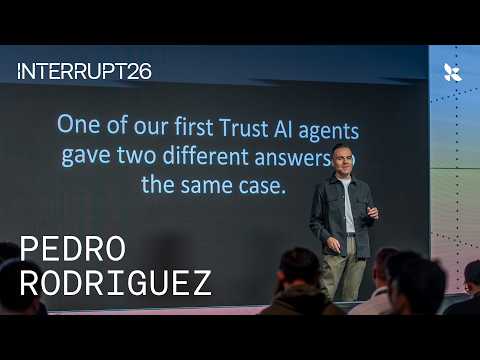
How Airbnb builds Trust for Guests and Hosts using AI Agents with LangGraph

Video thumbnail: How Airbnb builds Trust for Guests and Hosts using AI Agents with LangGraph
Nov 9, 202618m 51s video lengthLangChain

The Signal

Building AI agents for high-stakes decision-making, such as insurance claims or loan approvals, is fundamentally different from prototyping. At Airbnb, engineers found that plausible-sounding model output is insufficient, leading them to prioritize auditability and consistency over raw performance. The primary challenge is not the agent itself, but the verification layer that prevents confident errors.

The Case

Architectural Safeguards

  • Airbnb uses a "checker" model—a separate, different model family—to verify that identical inputs yield identical outputs, preventing the agent from relying on its own self-consistent biases.15:04
  • All agent data access is strictly gated through an MCP (Model Context Protocol) layer, which acts as the only path for API or database queries and enforces mandatory logging for future accountability.10:47
  • Trust workflows treat the "run" and the "case" as separate entities; state is persisted outside the graph because cases often require days or weeks to resolve, necessitating cross-run queries like SLA compliance monitoring.9:32

Dealing with Uncertainty

  • The team intentionally allows agents to "abstain" from making a decision, accepting that a forced, confident wrong answer is more damaging than deferring to a human reviewer.5:55
  • Initial versions suffered from a 25% abstain rate, which was mitigated by decomposing the workflow into two distinct calls: one to isolate the relevant policy and a second to generate the final decision.6:26
  • In the support assistant domain, training targets were shifted from choosing the "best-sounding" response to selecting the human agent’s actual historical reply, a move that successfully stopped policy drift caused by the model optimizing for tone over accuracy.12:35

The 1 Minute Signal Take

Designing trustworthy agents requires accepting higher costs and latency in exchange for structured, verifiable, and interruptible workflows. Relying on aggregate eval scores is insufficient; you must implement per-run verification and independent judges to catch failures that look plausible but are substantively incorrect.

Pro Analysis

Why It Matters

This talk represents a significant shift from 'AI as a chatbot' to 'AI as a reliable enterprise component.' By detailing how to manage high-stakes decisions—where errors directly impact user livelihoods—Airbnb provides a blueprint for moving AI systems out of labs and into production environments where accuracy and explainability are existential requirements.

Strategic Implications

Airbnb’s approach suggests that the future of agentic AI is not about bigger models, but better middleware. The emphasis on the Model Context Protocol (MCP) and independent verification suggests that organizations should pivot their engineering resources from prompt engineering to building robust 'guardrail' architectures that enforce data isolation and consistency.

Evidence & Hype Audit

While the talk is highly practical, it remains a promotional case study. The reported performance metrics (e.g., 45% resolution rate) are self-reported and lack the context of baseline comparisons. However, the technical patterns discussed (decomposition, state management, and independent judges) are standard, high-integrity architectural principles that lend high credibility to their specific operational design.

Counterarguments

Critics might argue that Airbnb’s 'modular' approach is overkill for many companies. The added latency and cost of running multiple subagents and distinct checker models may be prohibitive for smaller startups. Furthermore, some researchers argue that 'judge models' are prone to the same systemic biases as the agents they supervise, suggesting that human-in-the-loop is the only true safety mechanism.

Who Should Care

  • ML Engineers: Focus on the modular decomposition and state management patterns.
  • Product Managers: Evaluate the 'abstention' model for your own high-stakes workflows.
  • CTOs: Assess whether your current AI strategy relies on 'plausible' outcomes versus 'verified' reasoning.

What to Do Next

  • Implement a 'consistency check' today: send identical inputs to your agent and flag mismatches.
  • Audit your agent’s access path: remove direct database/API access in favor of a centralized evidence-logging layer.
  • Refactor 'one-shot' prompts into a multi-step workflow using subagents.
  • Define your 'abstain' policy: what exact scenarios should trigger human intervention?
Time saved:15m 38s

Share this

Tags

Written by: 1 Minute Signal Editorial Team