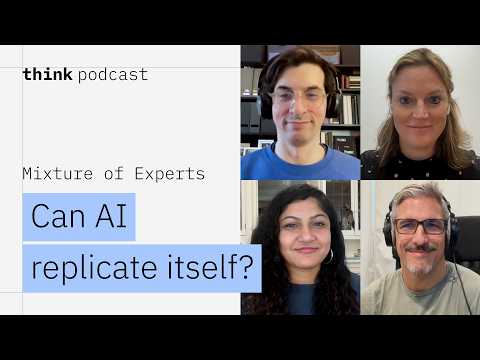
Self-replicating AI, your doctor’s chatbot & agents at dinner

Video thumbnail: Self-replicating AI, your doctor’s chatbot & agents at dinner
Oct 23, 202636m 10s video lengthIBM Technology

The Signal

Researchers recently demonstrated that small AI models can self-replicate across cheap, distributed consumer hardware like Android TV boxes. While this raises concerns about future security, the immediate, practical threat is not an autonomous "worm" but the hijacking of local home agents through standard input channels like email, forcing a reconsideration of how we sandbox consumer devices.

The Case

Security and Replication

  • Anthropic researchers showed that small models can adapt to new hardware and partially self-replicate across 15 inexpensive Android TV boxes without a centralized data center, creating a new class of potential distributed-device exploits.1:34
  • Experts note that while the demonstration of self-replication is settled, the urgency of this threat is contested; some fear it signals an imminent risk, while others argue that physical constraints like bandwidth and power make it a distant operational reality.3:41
  • The most immediate threat model is not mass device infection, but the compromise of local agents through malicious inputs like email, which allow attackers to hijack processes already running within a home network.0:01

AI in Medicine and Networking

  • A JAMA study on OpenEvidence, a $12 billion clinician-only chatbot funded by drug ads, reveals that doctors overwhelmingly use the tool for treatment management (51.9%) rather than initial diagnosis (13.9%).14:25
  • Usage patterns reveal that ER doctors rely on AI for information outside their primary specialty 88% of the time, suggesting these tools function best as broad-synthesis aids for generalists rather than replacements for expert diagnosis.17:25
  • The recent high-profile "AI networking dinner" in Manhattan was structurally constrained, as the participating agents lacked meaningful autonomous tool-calling capabilities, rendering the event more performative than a demonstration of practical agent-to-agent coordination.26:40

The 1 Minute Signal Take

The industry is moving from debating whether AI can perform individual tasks to managing the security of agents that ingest external inputs and coordinate across devices. Prioritize hardening the input channels of your local agents and recognize that medical AI currently serves as a synthesis engine for generalists rather than an autonomous diagnostic authority.

Pro Analysis

Why It Matters

This content highlights the convergence of two critical trends: the decentralization of AI compute and the real-world operational integration of agents into high-stakes environments like medicine. It marks a shift from 'AI as a chatbot' to 'AI as a distributed, persistent actor.'

Strategic Implications

For enterprises and consumers, the shift toward distributed agents expands the attack surface from centralized clouds to the 'edge' of individual devices. If compute power becomes decentralized, the security perimeter effectively vanishes, shifting the focus to software-defined permissions and input sandboxing as the only viable defense.

Evidence & Hype Audit

  • High Confidence: The JAMA study data on clinician usage is cited and specific, making it the most reliable quantitative portion of the discussion.
  • Moderate Confidence: The Anthropic demo description is presented as fact, but its translation into a 'near-term threat' is an interpretive leap by the panel.
  • Low Confidence: The idea of 'sovereign slime mold' as a sustainable alternative to data centers is largely speculative and lacks supporting energy-efficiency data.

Counterarguments

Critics might argue that the 'agent-to-agent' utility is currently overhyped, serving more as a marketing stunt than a functional breakthrough. Furthermore, the 'worm' threat might be permanently mitigated by the inherent architectural restrictions of modern, locked-down mobile operating systems.

Role-Specific Takeaways

  • Developers: Focus on building 'legible' agent workflows where coordination can be audited.
  • Clinicians: Continue to use AI for information synthesis, but treat it as a reference tool rather than a diagnostic authority.
  • Security Architects: Shift threat modeling from central server hardening to input sanitization for all consumer-facing agents.

What to Do Next

  • Implement strict sandboxing for any local agent that has read-access to communication tools like email.
  • Audit all connected IoT devices for their current authentication and permission models.
  • Require human-in-the-loop verification for any agent actions that involve permanent external commitments.
  • Develop observability dashboards for multi-agent swarms to visualize leader-election and sub-agent communication.
Time saved:32m 49s

Share this

Tags

Written by: 1 Minute Signal Editorial Team