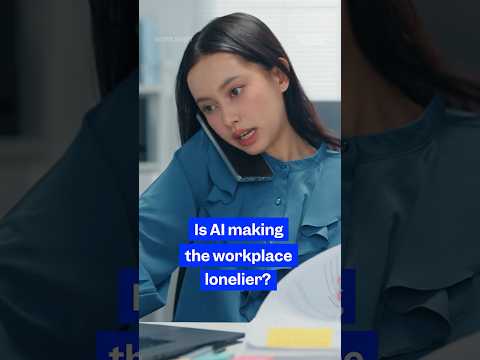
AI may be making workers more productive — and more isolated. #AI #workplace #productivity

Video thumbnail: AI may be making workers more productive — and more isolated. #AI #workplace #productivity
Jun 26, 20261m 19s video lengthBusiness Insider

The Signal

AI is increasingly replacing human-to-human interaction in the workplace, as employees route help-seeking and feedback requests to automated tools instead of colleagues. While this may boost efficiency, it creates a tension: companies must navigate the trade-off between reducing workplace noise and preserving the collaboration essential to team cohesion and retention.

The Case

  • A marketing director says he now speaks to co-workers about 50% less because he uses ChatGPT rather than asking human designers or engineers for assistance.0:06
  • Cisco, which monitors internal data, found that its most active AI users trusted their teams less than intermittent users, a trend they attribute to workers spending more time in isolation.0:22
  • BetterUp, a platform for talent development, reports that employees using AI as a stand-in for manager or mentor feedback display lower team coordination and higher rates of burnout.0:39
  • The same BetterUp data suggests these AI-reliant employees report a greater desire to quit their jobs, though the transcript presents these findings as correlational rather than definitive proof of causality.
  • Experts suggest individual AI adoption may be riskier than collective implementation, as the former can unintentionally erode social bonds and team trust.

The 1 Minute Signal Take

The claims linking AI to workplace isolation are plausible but rely entirely on correlational data provided by interested parties like BetterUp and Cisco, leaving the true extent and causality of these effects unproven. Watch this if you want quick, anecdotal examples of how AI substitution is shifting professional norms, but you can skip it; this summary effectively captures the core tension and the primary evidence cited.

Pro Analysis

Strategic Significance:

The shift toward AI-mediated workflows threatens to turn the collaborative office into a collection of isolated silos. If interpersonal problem-solving is replaced by machines, the traditional social capital—trust, tacit knowledge transfer, and mentorship—will evaporate, potentially weakening institutional memory in the long term.

Who Should Care:

  • HR and People Ops Leaders: You need to monitor the 'social health' of teams where individual AI adoption is high; productivity metrics may mask declining retention.
  • Managers: You must actively guard your role as a feedback provider, as AI is proving to be a direct competitor for the growth-oriented conversations currently keeping your team together.

Contrarian Takeaway:

The most productive workers might, ironically, be your most flighty. If 'high efficiency' is actually just 'hiding at a computer,' your top performers may be the ones most likely to quit, as their lack of social tethering reduces the switching costs of finding a new job.

Share this

Tags

Written by: 1 Minute Signal Editorial Team