
Channel: Council on Foreign Relations
How AI is being used in the Iran war
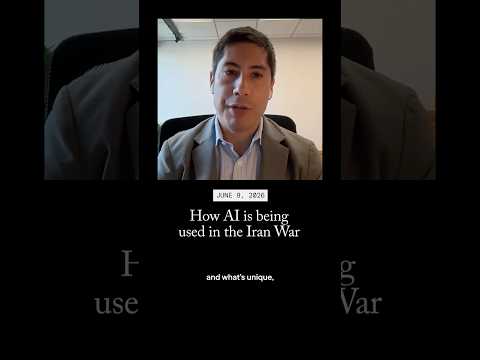
The Signal
Experts identify the recent Iran war as a primary case study for the unprecedented scale of AI-assisted warfare, citing over 13,000 strikes executed via Palantir’s Maven smart system in about 38 days. While the speaker asserts this deployment was uniquely transparent and wide-reaching compared to previous integration in Ukraine, Gaza, and Lebanon, the claim of historical uniqueness remains an interpretative framing rather than a verified fact.
The Case
- Speaker estimates over 13,000 AI-assisted strikes were launched during a 38-day window, a figure presented to illustrate a scale and pace of operations purportedly unmatched in modern conflict.
- AI-driven targeting is framed not as a novel technology, but as an operational shift toward transparency and reach, with the speaker explicitly positioning this war as a public demonstration of utility for other major militaries.
- The narrative distinguishes this campaign from prior deployments in Ukraine, Gaza, and Lebanon, arguing that while those conflicts used similar software, the Iran war provided a more robust and visible proof of concept.
- Key quantitative and strategic claims, including the exact strike count and the uniqueness of the scale, are provided by the speaker without independent, public datasets or verifiable operational audit logs.
The 1 Minute Signal Take
The video offers a useful quantitative benchmark for AI in warfare but relies heavily on the speaker’s subjective interpretation of "uniqueness" to sell the narrative. Skip this unless you are specifically looking for the speaker's rhetorical framing of Palantir's role, as the core facts are fully contained in this summary.
Channel: Council on Foreign Relations